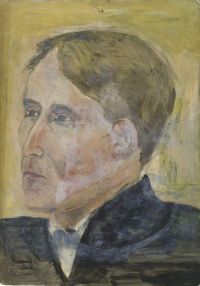
“ At morning there are flowers to cut the heart, And evening drives them on the eastward-flowing waters. Petals are on the gone waters and on the going, And on the back-swirling eddies, But to-days men are not the men of the old days, Though they hang in the same way over the bridge-rail. The sea's colour moves at the dawn And the princes still stand in rows, about the throne, And the moon falls over the portals of Sei-go-yo, And clings to the walls and the gate-top. With head-gear glittering against the cloud and sun, The lords go forth from the court, and into far borders. ”
Bai Li
Biographical details
Bai Li published works such as Lustra of Ezra Pound, Cathay and The Poet Li Po, A.D. 701-762. These writings evoke Li Po, poems and poetry.
Quotes by Bai Li
“ The eastern wind brings the green colour into the island grasses at Yei-shu, The purple house and the crimson are full of Spring softness. South of the pond the willow-tips are half-blue and bluer, Their cords tangle in mist, against the brocade-like palace. Vine-strings a hundred feet long hang down from carved railings, And high over the willows, the fine birds sing to each other, and listen, Crying—"Kwan, Kuan," for the early wind, and the feel of it. The wind bundles itself into a bluish cloud and wanders off. ”
Bai Li, The Poet Li Po, A.D. 701-762
“ I fear I shall never return from my westward wandering; the way is steep and the rocks cannot be climbed.Sometimes the voice of a bird calls among the ancient trees—a male calling to its wife, up and down through the woods. Sometimes a nightingale sings to the moon, weary of empty hills.It would be easier to climb to Heaven than to walk the Szechwan Road; and those who hear the tale of it turn pale with fear.Between the hill-tops and the sky there is not a cubit’s space. Withered pine-trees hang leaning over precipitous walls. ”
Bai Li, The Poet Li Po, A.D. 701-762
“ A cup of wine, under the flowering-trees: I drink alone, for no friend is near. Raising my cup, I beckon the bright moon, For he, with my shadow, will make three men. The moon, alas! is no drinker of wine: Listless, my shadow creeps about at my side. Yet with the moon as friend and the shadow as slave I must make merry before the Spring is spent. To the songs I sing the moon flickers her beams; In the dance I weave my shadow tangles and breaks. ”
“ To-Em-Mei’s “The Unmoving Cloud” “Wet springtime,” says To-em-mei, “Wet spring in the garden.” I. The clouds have gathered, and gathered, and the rain falls and falls, The eight ply of the heavens are all folded into one darkness, And the wide, flat road stretches out. ”
“ But shall have his sorrow for sea-fare Whatever his lord will. He hath not heart for harping, nor in ring-having Nor winsomeness to wife, nor world's delight Nor any whit else save the wave's slash, Yet longing comes upon him to fare forth on the water. Bosque taketh blossom, cometh beauty of berries, Fields to fairness, land fares brisker, All this admonisheth man eager of mood, The heart turns to travel so that he then thinks On flood-ways to be far departing. Cuckoo calleth with gloomy crying, He singeth summerward, bodeth sorrow, The bitter heart's blood. ”
“ Over a thousand gates, over a thousand doors are the sounds of spring singing, And the Emperor is at Ko. Five clouds hang aloft, bright on the purple sky,{72} The imperial guards come forth from the golden house with their armour a-gleaming. The Emperor in his jewelled car goes out to inspect his flowers, He goes out to Hori, to look at the wing-flapping storks, He returns by way of Sei rock, to hear the new nightingales, For the gardens at Jo-run are full of new nightingales, Their sound is mixed in this flute, Their voice is in the twelve pipes here. ”
Bai Li, The Poet Li Po, A.D. 701-762
“ Their sorrow was deep as the waters of the Lake that go straight down a thousand miles. Dark clouds blackened the sun. Shōjō [19] howled in the mist and ghosts whistled in the rain. The queens said, “Though we speak of it we cannot mend it. High Heaven is secretly afraid to shine on our loyalty. [13] But the thunder crashes and bellows its anger, that while Yao and Shun are here they should also be crowning Yü. When a prince loses his servants, the dragon turns into a minnow. When power goes to slaves, mice change to tigers. ”
“ The enemy is swift, we must be careful. When we set out, the willows were drooping with spring, We come back in the snow, We go slowly, we are hungry and thirsty, Our mind is full of sorrow, who will know of our grief? ”
“ The Dai horse neighs against the bleak wind of Etsu, The birds of Etsu have no love for En, in the north, Emotion is born out of habit. Yesterday we went out of the Wild-Goose gate, To-day from the Dragon-Pen. [1] Surprised. Desert turmoil. Sea sun. Flying snow bewilders the barbarian heaven. Lice swarm like ants over our accoutrements. Mind and spirit drive on the feathery banners. Hard fight gets no reward. Loyalty is hard to explain. ”
Bai Li, The Poet Li Po, A.D. 701-762
“ I have often thought that Chinese poets are very limited in their range. They seem to be deficient in the quality of imagination. China has never produced a great epic poem. Of course I speak subject to correction, but I believe I am right in saying that China has never produced a poet comparable with Homer, Dante, Virgil, or Milton. There has been no one born with the power of telling a story like Homer. The poets of China appear to me to be emotional and descriptive, but incapable of any high flights of imagination. ”
“ Who has brought the army with drums and with kettle-drums? Barbarous kings. A gracious spring, turned to blood-ravenous autumn, A turmoil of wars-men, spread over the middle kingdom, Three hundred and sixty thousand, And sorrow, sorrow like rain. Sorrow to go, and sorrow, sorrow returning, Desolate, desolate fields, And no children of warfare upon them, No longer the men for offence and defence. ”
Bai Li, The Poet Li Po, A.D. 701-762
“ In China every child who has studied poetry knows something about Tu Fu’s poems. Tu Fu is placed first by the Chinese because he is the greatest national poet. He expresses national feelings in a way that can be appreciated by everybody. Li T’ai-po’s poems deal chiefly with wine and women, love and sensual things, but Tu Fu’s poems are full of men and women, elderly people and children, their joy, their anguish, the hardship of the soldier, and things of that sort. In a word, Tu Fu’s poetry expresses what we ordinary men and women wish to express and cannot. ”
“ It is odd that you should be covered with long robes and trailing tendrils and flowers; It is odd that you should be changing your face and resembling some other woman to plague me; It is odd that you should be hiding yourself In the cloud of beautiful women who do not concern me. ”
“ The birds flutter to rest in my tree, and I think I have heard them saying, “It is not that there are no other men But we like this fellow the best, But however we long to speak He can not know of our sorrow.” ”
Bai Li, The Poet Li Po, A.D. 701-762
“ Many vulgar people expressed surprise, but Wang replied: ‘The reason why vulgar people find Li Po’s poetry congenial is that it is easy to enjoy. His intellectual outlook was mean and sordid, and out of ten poems nine deal with wine or women; nevertheless, the abundance of his talent makes it impossible to leave him out of account.’”Finally Huang T’ing-chien (A.D. 1050-1110) , accepted by the Chinese as one of their greatest writers, says with reference to Li’s poetry: “The quest for unusual expressions is in itself a literary disease. ”
“ Gilt turquoise and silver are in the place of thy rest. A brown robe, with threads of gold woven in patterns, hast thou gathered about thee, O Nathat-Ikanaie, “Tree-at-the-river.” As a rillet among the sedge are thy hands upon me; Thy fingers a frosted stream. Thy maidens are white like pebbles; Their music about thee! There is none like thee among the dancers; None with swift feet.{22}April Nympharum membra disjecta. ”
Bai Li, The Poet Li Po, A.D. 701-762
“ In Li’s whole works there are said to be only nine poems in the strict seven-character metre. Most of his familiar short poems are in the old style, which neglects the formal arrangement of tones. The value of his poetry lay in beauty of words, not in beauty of thought. Unfortunately no one either here or in China can appreciate the music of his verse, for we do not know how Chinese was pronounced in the eighth century. Even to the modern Chinese, his poetry exists more for the eye than for the ear. ”
“ This lady in the white bath-robe which she calls a peignoir Is, for the time being, the mistress of my friend, And the delicate white feet of her little white dog Are not more delicate than she is, Nor would Gautier himself have despised their contrasts in whiteness As she sits in the great chair Between the two indolent candles. ”
Bai Li, The Poet Li Po, A.D. 701-762
“ If you have the practical it does not necessarily follow that you are lacking in the spiritual. As for present-day Chinese poets, there are several famous ones in China.Since the lecturer has raised the question whether Li T’ai-po or Tu Fu is the greater poet, I would say that the Chinese of the present day consider Tu Fu to be the greater. It strikes me as curious that European people who know something about Chinese poetry should prefer Li T’ai-po. Perhaps very few people have heard of Tu Fu. Certainly there is no translation of the most important of Tu Fu’s poems in the English language. ”
Bai Li, The Poet Li Po, A.D. 701-762
“ A man may be an excellent writer and translator, and not be a poet, but to translate foreign poetry into English considerable literary gifts are required.Mr. Paul King: All of you who have been lately in China must be struck with the extraordinary difference between the China described in these poems and the China which has come into being since the revolution. Ideas of a very practical nature have now taken possession of the people. And then, what about modern Chinese poets? Do any of us know of any? In my intercourse with the Chinese I cannot recall a modern Chinese who was a poet. ”
“ The canopy embroidered with dragons drinks in and casts back the sun. Evening comes. The trappings are bordered with mist. The hundred cords of mist are spread through and double the trees, Night birds, and night women, spread out their sounds through the gardens.{92}II. Birds with flowery wing, hovering butterflies crowd over the thousand gates, Trees that glitter like jade, terraces tinged with silver, The seed of a myriad hues, A net-work of arbours and passages and covered ways, Double towers, winged roofs, border the net-work of ways: A place of felicitous meeting. ”
“ Here we are because we have the Ken-nin for our foemen, We have no comfort because of these Mongols. We grub the soft fern-shoots, When anyone says “Return,” the others are full of sorrow. Sorrowful minds, sorrow is strong, we are hungry and thirsty. Our defence is not yet made sure, no one can let his friend return. ”
Bai Li, The Poet Li Po, A.D. 701-762
“ It is quite true that there are no epic poems in Chinese literature. This form of poetry has not been introduced in China, but I differ with your statement, Sir, that Chinese poetry lacks imagination. (Applause.) I could give you many instances to the contrary, though not from memory. The last speaker’s remark that the present China is different from what China is in Chinese poetry may be true, but I may well retort that the England as represented in Shakespeare is very different from the England of to-day. ”
“ But if I give them, with the necessary breaks for explanation, and a tedium of notes, it is quite certain that the personal hatred in which I am held by many, and the invidia which is directed against me because I have dared openly to declare my belief in certain young artists, will be brought to bear first on the flaws of such translation, and will then be merged into depreciation of the whole book of translations. ”
“ You’d have men’s hearts up from the dust And tell their secrets, Messire Cino, Right enough? Then read between the lines of Uc St. Cire, Solve me the riddle, for you know the tale. Bertrans, En Bertrans, left a fine canzone: “Maent, I love you, you have turned me out. The voice at Montfort, Lady Agnes’ hair, Bel Miral’s stature, the vicountess’ throat, Set all together, are not worthy of you ...” And all the while you sing out that canzone, Think you that Maent lived at Montaignac, One at Chalais, another at Malemort Hard over Brive—for every lady a castle, Each place strong. ”
Bai Li, The Poet Li Po, A.D. 701-762
“ At the feast our spirits had soared to the Nine Heavens, but before evening we were scattered like stars or rain, flying away over hills and rivers to the frontier of Ch’u. I went back to my mountain to seek my old nest, and you, too, went home, crossing the Wei Bridge.Then your father, who was brave as leopard or tiger, became Governor of Ping-chou [39] and put down the rebel bands. ”
Bai Li, The Poet Li Po, A.D. 701-762
“ Since the Middle Ages the Chinese have been almost unanimous in regarding Li Po as their greatest poet, and the few who have given the first place to his contemporary Tu Fu have usually accorded the second to Li.One is reluctant to disregard the verdict of a people upon its own poets. We are sometimes told by Frenchmen or Russians that Oscar Wilde is greater than Shakespeare. We are tempted to reply that no foreigner can be qualified to decide such a point. ”
Bai Li, The Poet Li Po, A.D. 701-762
“ The guardian of the Pass leaps like a wolf on all who are not his kinsmen.In the daytime one hides from ravening tigers and in the night from long serpents, that sharpen their fangs and lick blood, slaying men like grass. ”
“ To Formianus’ Young Lady Friend After Valerius Catullus All Hail! young lady with a nose by no means too small, With a foot unbeautiful, and with eyes that are not black, With fingers that are not long, and with a mouth undry, And with a tongue by no means too elegant, You are the friend of Formianus, the vendor of cosmetics, And they call you beautiful in the province, And you are even compared to Lesbia. O most unfortunate age!{52}Tame Cat “It rests me to be among beautiful women. ”
Bai Li, The Poet Li Po, A.D. 701-762
“ The obsession of impermanence has often been sublimated into great mystic poetry. In Li Po it results only in endless restatement of obvious facts.It has, I think, been generally realized that his strength lies not in the content, but in the form of his poetry. Above all, he was a song-writer. Most of the pieces translated previously and most of those I am going to read to-day are songs, not poems. It is noteworthy that his tombstone bore the inscription, “His skill lay in the writing of archaic songs.” ”
Bai Li, The Poet Li Po, A.D. 701-762
“ This characteristic, common to most Chinese poetry, is carried to an extreme point in the fifty-nine Old Style poems with which the works begin. Not only do they bristle with the names of historical personages, but almost every phrase is borrowed from some classic. One is tempted to quarrel with Wang An-shih’s statement that people liked the poems because they were easy to enjoy. No modern could understand them without pages of commentary to each poem. But Chinese poetry, with a few exceptions, has been written on this principle [5] since the Han dynasty ”
“ There is no ease in royal affairs, we have no comfort. Our sorrow is bitter, but we would not return to our country. What flower has come into blossom? Whose chariot? The General’s.{68} Horses, his horses even, are tired. They were strong. ”
“ And there came also the “True man” of Shi-yo to meet me, Playing on a jewelled mouth-organ. In the storied houses of San-Ko they gave us more Sennin music, Many instruments, like the sound of young phoenix broods. ”
Bai Li, The Poet Li Po, A.D. 701-762
“ I grant that his works show unparalleled talent and originality, but not one in ten contains any moral reflection or deeper meaning. [2] “Tu Fu’s poems are very numerous; perhaps about 1,000 of them are worth preserving. In the art of stringing together allusions ancient and modern and in the skill of his versification in the regular metres he even excels Li Po. But such poems as the ‘Pressgang,’ [1] and such lines as “‘At the Palace Gate, the smell of wine and meat; Out in the road, one who has frozen to death’form only a small proportion of his whole work.” ”
“ And the dancers, you write a sonnet, Say “Forget To-morrow,” being of all men The most prudent, orderly, and decorous! “Pepita” has no to-morrow, so you write. Pepita has such to-morrows: with the hands puffed out, The pug-dog’s features encrusted with tallow Sunk in a frowsy collar—an unbrushed black. She will not bathe too often, but her jewels{110} Will be a stuffy, opulent sort of fungus Spread on both hands and on the up-pushed bosom— It juts like a shelf between the jowl and corset. ”