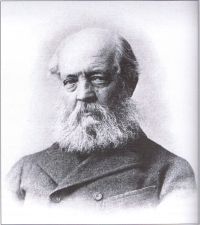
“ The South, perceiving the benefits of slavery, was blind to its fundamental weaknesses, and the North, unacquainted with Negro character, held to the natural equality of all men. Thus slavery itself became a barrier to the getting of an adequate knowledge of the needs of the slave. The feeling grew that if the shackles of slavery were broken, the Negro would at once be as other men. The economic differences finally led to the war. It is not to be forgotten that slavery itself was not the cause of the war, nor was there any thought on the part of the Union leaders to make the blacks citizens. ”
Carl Kelsey
Biographical details
Carl Kelsey (1870-1953) published works such as The Negro Farmer. These writings evoke Negro, whites and cotton.
Quotes by Carl Kelsey
“ American slavery was a great curse to both races, and I would be the last to apologize for it, but, in the providence of God, I believe that slavery laid the foundation for the solution of the problem that is now before us in the South. During slavery the Negro was taught every trade, every industry, that constitutes the foundation for making a living. ”
“ To my mind the Negro must work out his salvation, economic and social. It cannot be given without destroying the very thing we seek to strengthen—character. This is the justification for the emphasis now laid upon industrial training. This training and the resulting character are the pre-requisites of all race progress. Industrial education is thus not a fad nor a mere expedient to satisfy the selfish demands of southern whites. It is the foundation without which the superstructure is in vain. ”
“ The black passes from an enervating, humid climate to one in which activity is pleasurable. From the isolation and self-satisfaction of savagery he emerges into close contact with one of the most ambitious and progressive of peoples. Life at once becomes far more secure and wrongs are revenged by the self-interest of the whites as well as by the feeble means of self-defense in possession of the blacks. That there were cruelties and mistreatment under slavery goes without saying, but the woes and sufferings under it were as nothing compared to those of the life in the African forests. ”
“ It is clear that any civilization which is based on the fertility of the soil, and not on the energy of man, contains within itself the seed of its own destruction. Where food is easily obtained, where there is little need for clothing or houses, where, in brief, unaided nature furnishes all man's necessities, those elements which produce strength of character and vigor of mind are wanting, and man becomes the slave of his surroundings. ”
“ We have attempted to have the Negro do in a few years what it has taken us thousands to accomplish, and are surprised that he has disappointed us. There is no room for discouragement. Contrast the Negro in Africa and America to see what has been done.Unless this unreliability is overcome it will form even a greater handicap for the future. Southern methods of agriculture have been more wasteful of small economies than have Northern. That a change is imperative, in many districts at least, has been shown. ”
“ Until the Negro is big enough for his labor to be plainly profitable to his master he has no training to application or method, but only to idleness and carelessness. Before children arrive at a working age they hardly come under the notice of their owner.... The only whipping of slaves I have seen in Virginia has been of these wild, lazy children, as they are being broke in to work. They cannot be depended upon a minute out of sight. ”
“ The North is slowly learning that the Negro is not a dark-skinned Yankee, and that thousands of generations in Africa have produced a being very different from him whose ancestors [Pg 7] lived an equal time in Europe. In a word, we now see that slavery does not account for all the differences between the blacks and whites, and that their origins lie farther back. Our acquaintance with the ancestors of the Negro is meager. We do not even know how many of the numerous African tribes are represented in our midst. A good deal of Semitic blood had already been infused into the more northern tribes. ”
“ There is now no one who is responsible for food and clothing. For a time all is in confusion. The war had wiped out the capital of the country. The whites were land poor, the Negroes landless. It so happened that at this time the price of cotton was high. The Negro knew more about cotton than any other crop. Raise cotton became the order of the day. The money lenders would lend money on cotton, even in advance, for it had a certain and sure ready sale. Thus developed the crop-lien system which in essence consists in taking a mortgage on crops yet to be raised. ”
“ With us race riots are unknown, and we have but one Negro problem—though that constantly confronts us—how to secure more Negroes." Evidently when we hear reports of states of siege and rumors of race war, we are not to understand that this is the normal, typical condition of the entire South. If this is the real situation, it seems clear that the geographical segregation plays no mean part in determining the relation of the two races. ”
“ The impression one gets from traveling about is that the extensive cultivation of tobacco, in spite of the fact that it is the cash crop and perhaps also the most profitable, is really a drawback in that other possibilities are obscured. It may be that the line of progress will not be to abandon tobacco, but to introduce more intensive cultivation, for the average man, white or black, does not get a proper return from an acre. ”
“ We do not even know how many full blooded Africans there are in America, nor does the last census seek to ascertain. Mulattoes have almost entirely been the offspring of white fathers and black mothers, and probably most of the fathers have been boys and young men. Without attempting a discussion of this subject, whose results ethnologists cannot yet tell, it is certain that a half breed is not a full blood, a mulatto is not a Negro, in spite of the social classification to the contrary. ”
“ The country school taught by a teacher, usually incompetent from any standpoint, whose interest has been chiefly in the larger salary made possible by his "higher education" has not been an unmixed blessing. The children have learned to read and write and have preserved their notion that if only they could get enough education they might be absolved from manual labor. Even today Hampton and Tuskegee and similar schools have to contend with the opposition of parents who think their children should not be compelled to work, for they are sent to school to enable them to avoid labor. ”
“ Will the Negro be in a position of independence or will he only assist the white? Will he till in the future the best lands or will he be forced to the less fertile? With the knowledge of the present regarding yellow fever, malaria and typhoid the dread of the lowlands is disappearing. If the indications point, as many believe, towards the South as the seat of the next great agricultural development these questions become of vital importance to the Negro. ”
“ The Negro has a great advantage over the Italian or other European peasant in that the white man prefers him as a helper. He is patient, docile and proud of his work. He is wanted by the native whites, and if the reader doubts this let him go to any Southern community and attempt to bring about any great exodus of the Negroes and he will be surprised to find how soon he is requested to move on. This interest on the part of the whites is a factor which must be considered. It would be a happy day for the Negro if the white woman of the South took her old personal interest in his welfare. ”
“ It seems that in all matters outside of business relations the whites have less and less to do with the blacks. If this division is to continue, we may well ask what is its significance for the future.This geographical segregation evidently had causes which were largely economic. Probably the most potent factor to-day in perpetuating it is social, i. e., race antagonism. The whites do not like to settle in a region where they are to compete with the Negro on the farms as ordinary field hands. Moreover, the Negroes retain their old-time scorn of such whites and despise them. ”
“ If some of these primary lessons have not been mastered what chance is there that the Negro will overcome, unaided, the crop lien system and his other handicaps and introduce diversified agriculture, stock raising, etc.? Slavery taught him something about work and he is willing to work, and work hard, under leadership. Herein lies the possibility of his economic salvation. He is not yet ready as a race to stand alone and advance at the pace demanded by America of the twentieth century. ”
“ I would not be so foolish as to say that assaults upon white women may not take place anywhere, but as a matter of fact they seem to occur chiefly in those regions where white and black meet as competitors for ordinary labor. Beaufort County, South Carolina, has a black population forming about 90 per cent of the total, yet I was told last summer that but one case of rape had been known in the county, and that took place on the back edge of the county where there are fewest Negroes, and was committed by a non-resident black upon a non-resident white. ”
“ If we are to base our reasoning on the table cited we might argue that land ownership is a bad thing for Negroes, for tenants of both classes among them produced more than did the owners. The white cash tenants also produced more than white owners. In explaining this it is said: "The fact that cash tenants pay a fixed money rental per acre causes them to rent only such area as they can cultivate thoroughly, while many owners who are unable to rent their excess acreage to tenants attempt to cultivate it themselves, thus decreasing the efficiency of cultivation for the entire farm." ”
“ Viewed from this standpoint, though it is equally true from another, one of the great needs of the South is that its white farmers should pay more attention to other things than cotton. So long as land is considered too valuable to use for pasture, for hay, for the various crops on which stock live and fatten, or so long as it is considered profitable to sell cotton seed for $5 a ton and throw away four or five times this amount in the food and manure which the same seed contains, the Negro will not see the advantage of a different system. ”
“ Acts which are undeniably quite natural, since they are the expression of a primordial need, essential to the duration of the species, but which a long ancestral and individual education has trained us to subject to a rigorous restraint, and to the accomplishment of which, consequently, we can not help attaching a certain shame, do not in the least shock the still imperfect conscience of the primitive man." From somewhat this standpoint we must judge of the Negro. ”
“ Moreover, the merchant by specious reasoning often justifies his own conduct. He says that the Negro will spend his money at the first opportunity and that he might just as well have it as some other merchant. I would not be understood as saying that this action is anything but the great exception but there are dishonest men everywhere who are ready to take advantage of their weaker fellows and the Negro suffers as a result, just as the ignorant foreigner does in the cities of the North.The interest may also be reckoned into the face of the mortgage. ”
“ Hoes, heavy and clumsy, were the common tools. Within a year I have seen grass being mowed with hoes preparatory to putting the ground in cultivation. Even today the Negro has to be trained to use the light, sharp hoe of the North. Corn, cotton and, in a few districts, rice or tobacco were the staple crops, although each plantation raised its own fruit and vegetables, and about the cabins in the quarters were little plots for gardens. The land was cultivated for a time, then abandoned for new, while in most places little attention was paid to rotation of crops or to fertilizers. ”
“ A livelihood is easily gained. The creeks abound with fish, crabs and oysters. There is plenty of work on the farms for those who prefer more steady labor. Land valued at about $10 per acre may be rented for $1. More than ten acres to the tenant is not usual, and I was told that it is very common for a family to rent all the land it wants for $10 per year, the presumption being that not over ten acres would be utilized. The staple crop for the small farmer is the sea island cotton. ”
“ City conditions are more or less uniform in all sections. The geographical location of the farmer, however, is a matter of considerable importance not only as determining in large measure the crop he must raise, but as limiting the advance he may be able to make under given conditions. It is estimated that about 85 per cent of the men (Negroes) and 44 per cent of the women in productive pursuits are farmers. Their general location has been shown. For convenience we may divide the territory into five districts: (1) Virginia and Kentucky, above the limit of profitable cotton culture. ”
“ I have already mentioned that farm laborers were getting fewer, and those left are naturally the less reliable. Many white farmers are having considerable difficulty in carrying on their places. The result is that many are only partially cultivating the farms, and many of the younger men are abandoning agriculture. What the final result will be is hard to tell.In summarizing it may be said that agriculture is being somewhat neglected and that the opportunity to earn money in the oyster industry acts as a constant deterrent to agricultural progress, if it is not directly injurious. ”
“ The system existed among the white planters for many years before the war.A certain amount of food and clothing was advanced to the Negro family until the crop could be harvested, when the money value of the goods received was returned with interest. Perhaps nothing which concerns the Negro has been the subject of more hostile criticism than this crop-lien system. That it is easily abused when the man on one side is a shrewd and cunning sharpster and the borrower an illiterate and trusting Negro is beyond doubt. ”
“ It is often taken for granted that the Negro has practically equal opportunities in the various parts of the South, and that a fairly uniform rate of progress may be expected. This assumption rests on an ignorance of the geographical location of the mass of blacks. It will be shown that they are living in several distinct agricultural zones in which success must be sought according to local possibilities. Development always depends upon the environment, and we should expect, therefore, unequal progress for the Negroes. ”
“ With greater security of life came an emphasis, from without, to be sure, on better marital relations. In this respect slavery left much to be desired, but conditions on the whole were probably in advance of those in Africa. Marriage began to be something more than a purchase. ”
“ The average Negro boy or girl is allowed to grow. It is [Pg 62] difficult to say much more for the training received at home. We must remember that there is an almost total absence of home life as we understand it. The family seldom sits down together at the table or do anything else in common. The domestic duties are easily mastered by the girls and chores do not weigh heavily on the boys. At certain periods of the year the children are compelled to assist in the farm operations, such as picking cotton, but most of the time they are care free. ”
“ For this land a rental of from $6 to $8 per acre is paid, while plantations will rent for a term of years at an acre. A good deal of new land is brought in cultivation by offering it rent free to a Negro for three years, the tenant agreeing to clear off the timber and bring the soil under cultivation. On some plantations no interest is charged on goods advanced by the Negro usually pays 25 per cent. for all money he borrows. The white planter has to pay at least 8 per cent and agree to sell his cotton through the factor of whom the money is obtained and pay him a commission of 2.5 per cent. ”
“ The amusements of the blacks are simple. Nearly all drink, but drunkenness is not a great vice. Dances are in high esteem, and are often accompanied by much drinking and not infrequently by cutting scrapes, for the Negro's passions lie on the surface and are easily aroused. In South Carolina the general belief seems to be that the dispensary law has been beneficial. There is also a universal fondness for tobacco in all its forms. Gambling prevails wherever there is ready money and not infrequently leads to serious assaults. ”
“ The master must always furnish tools, land and seed, and see to it that the ground was cultivated. There was thus little necessity for the Negro to care for the morrow, and his African training had not taught him to borrow trouble. Thus neither Africa nor America had trained the Negro to independent, continuous labor apart from the eye of the overseer. The requirements as to skill were low. The average man learned little of the mysteries of fruit growing, truck farming and all the economies which make diversified agriculture profitable. ”
“ Into our public and other schools should be incorporated industrial training. If to regularity, punctuality, silence, obedience to authority, there be systematically added instruction in mechanical arts, the results would be astounding."The question of classical education does not now concern us. The absolutely essential thing is that the Negro shall learn to work regularly and intelligently. The lesson begun in slavery must be mastered. ”
“ The adaptability of cotton to the Negro is almost providential. It has a long tap root and is able to stand neglect and yet produce a reasonable crop. The grains, corn and cane, with their surface roots, will not thrive under careless handling.The average farmer knows, or at least utilizes few of the little economies which make agriculture so profitable elsewhere. The Negro is thus under a heavy handicap and does not get the most that he might from present opportunities. ”
“ This may be true of the whites, but it is a lame explanation for the blacks. Negro farmers who own more land than they can cultivate appear to be better known at Washington than they are locally. The trouble with the entire argument is that it assumes that the Negro is an independent cultivator of cotton. This is not quite the case. In all parts of the South the Negro, tenant or owner, usually receives advances from white factors, and these spend a good part of their time riding about to see that the land is cultivated in order to insure repayment of their loans. ”
“ To meet this handicap a more diversified agriculture must gradually supplant in some way the present over-attention to cotton. In early days Virginia raised much cotton, now it stands towards the bottom of the cotton states. Perhaps it is safe to say that Virginia land has been as much injured by the more exhaustive crop, tobacco, as the other states by cotton. Large areas have been allowed to go back to the woods and local conditions have greatly changed. How this diversification is to be brought about for the Negro is one of the most important questions. ”
“ Moreover, a considerable proportion of the farms owned are so small that they do not suffice to support the owners. Conditions vary in different districts. In Virginia it has been possible to buy a few acres at a very low price. In parts of Alabama, or wherever the land has been held in large estates in recent years, it has often been impossible for the Negro to purchase land in small lots. Thus, though I believe heartily in land ownership for the blacks and believe that well conducted land associations will be beneficial, I cannot think that this alone will solve the questions confronting us. ”