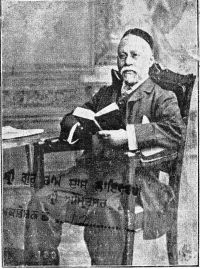
“ The soldiers of Islam were indeed sufficiently fanatical and violent to impose their laws and religion on the people, but not sufficiently numerous to effect any change in them. It would be practically quite the truth to say that this invasion has left no traces outside the families of the Seides. The language alone has felt its effects; all words connected with religion and government are Arabic. The Guebres should be all the less regarded as pure descendants of the Aryans, as they resemble their Mussulman neighbours, and are, on the other hand, not all of the same type. ”
Delphine Menant
Biographical details
Quotes by Delphine Menant
“ The reader will not, we hope, lose sight of their grievous exodus; and, at the height of the fame of the Dadiseths, the Banajis, the Jamshedji Jijibhoys, the Camas, the Petits, and many other no less illustrious names, will remember the first fugitives of Persia, and their kindly reception by the Rana of Sanjan. “Welcome,” said the prince, “welcome to those who walk faithfully in the way of Hormuzd! May their race prosper and increase! May their prayers obtain the remission of their sins, and may the sun smile on them! ”
“ One could see how the education and culture of women, instead of creating a cleft in the life of the family, as is so often erroneously imagined by those who oppose the cause of female education in India, proves a means of strengthening its unity and elevating its whole character. ”
“ In consideration of the innumerable benedictions which it has pleased the Almighty to accord to us, and as an act of grace towards Him who has given us the Royal Crown of Persia, with the means of promoting the welfare of its inhabitants, has devolved on us the duty of securing tranquillity and happiness for all our subjects, to whatever tribe, community, or religion they belong, so that they may be profited and refreshed by the beneficent waters of our special favour. ”
“ On leaving the argillaceous plateaus, the rocks and the sandhills, the town and the villages around seem to emerge from a veritable oasis of mulberry trees; the desert begins at the very foot of the walls, where the sand driven by the tempests is heaped up. ”
“ After the crisis of 1865 a serious decrease of the population in Bombay had been apprehended for a time; but it was an exaggerated fear which disappeared with the census of 1881. It has been proved, on the contrary, that the conditions of life among the Parsis, both as regards mortality and hygiene, have reduced the average of mortality among the individuals, grown-up men, women and children. These latter, well-tended and carefully brought up, supply a splendid race, susceptible of culture, and endowed with perfect health. ”
“ As we have seen, the followers of Zoroaster who would not accept the religion of Islam expatriated themselves. Those who could not abandon their country, and continued to cling to their old religion, had to resign themselves to frightful sufferings. These dwelt chiefly in Fars and Khorassan. European travellers who have visited Persia at different periods, have all been struck by their miserable and precarious condition, and have felt interested in their language, religion, and customs. ”
“ We have noticed only the chief events of its history, without stopping to gather any instruction from facts. Let it suffice to say that the same causes made the Arabs victorious over the Byzantine emperor and the Persian Shah-in-Shah, and that these causes were the weakness and exhaustion of the national dynasties in the presence of the vital elements of the conquerors. The people suffered from the carelessness of their kings; individual energy was powerless against the invasion of disciplined and fanatical tribes, commanded by generals like Omar and his officers. ”
“ Ignorance was the predominating vice of the Parsis of India. In order to remedy it, the Dastoor of Kirman formed some disciples, Darab at Surat, Djamasp at Naosari, and a third at Bharooch, to whom he taught Zend and Pehlvi. Some time after, tired of the contradictions which he had to endure, he returned to Kirman. The books which this Dastoor has left in India are an exact copy of the Zend and Pehlvi Vendidad, the Feroueschi, the translation of the Vadjerguerd, and the Nerenguestan. ”
“ Fars represents in our days the little province of Parsua, which has given its name to one of the greatest civilisations of antiquity. It is bounded on the west by Susiana, on the north and on the east by the Deserts of Khavir and Kirman, with a coast-line along the Persian Gulf between Bushire and Bunder Abbas. In ancient times the inhabitants, divided into tribes, led a simple, rustic life, superior in all respects to their neighbours the Medes, already enervated by civilisation. ”
“ It seems to us that a deputation from us to the Court of Persia, presented and duly supported by the English Ambassador at Teheran, might successfully attempt some negotiations with a view to put an end to the cruelty practised every day. The amount raised by the Capitation Tax with such useless violence must be to the Imperial treasury insignificant in the extreme, and there is no doubt that a representation from the Parsis of India has all chances of being favourably received. ”
“ It is in the presence of changes so sudden and so complete that one feels justified in raising the disquieting question of the influence of race and surroundings on the history of a nation. We do not need to address ourselves to modern thinkers to find it clearly formulated. ”
“ When the Arabs by right of conquest imposed a new religion on the Persians, the fusion of the Turano-Aryans had been already for the greater part accomplished in the north and east of the empire. At this time there was no difference of race, manners, customs or religion between the ancestors of the Mahomedan Persians and those of the real Guebres. Separated to-day as surely by their religion as by vast extent of space, they no longer commingle ”
“ He therefore permitted them to reside in the city on condition that they adopted the language of the country, and ceased to speak that of their ancestors; that their women should dress according to the Hindoo mode; that the men should no longer carry weapons, and should perform their marriage ceremonies at night, according to Hindoo custom. What could the unfortunate exiles, thirsting for peace and rest, do but accept these conditions? And this they did. They settled down in a vast tract of land not far from Sanjan, and with full hearts offered prayers to Hormuzd. ”
“ The Parsis are the descendants of the ancient Persians, whose fame has survived in the annals of the world. Reduced henceforth to perhaps the most restricted minority amongst all the nations of the globe, they are found dispersed all over the Presidency of Bombay, and in some districts of modern Persia, in Yezd and in Kirman, where they have been vegetating for centuries. ”
“ Those of Yezd have, according to Khanikoff, Aryan characteristics. It is not because they are Guebres, but because they dwell in a country adjoining Fars. Those of Teheran resemble the other inhabitants of Teheran. The Parsis of India, whose ancestors preferred exile to conversion, are more like the Parsis of Persia, and differ from their co-religionists of the North. Since their exodus, they have not at all mixed with the people who received them; they are such as they were then. Thus at the time of the Arabic conquest there was no single race. ”
“ Darab, the first disciple of Djamasp, and a Dastoor Mobed perfect in the knowledge of Zend and Pehlvi, wished to correct the Pehlvi translation of the Vendidad and rectify some portions of the Zend Text, which appeared to him either to have been transposed or to present useless repetitions. He began explaining to young Parsi theologians the works of Zoroaster, which the Mobeds read every day without understanding them. An enslaved people who for a long time practised a thousand ceremonies, the sense and reason of which they were ignorant of, would naturally fall into innumerable abuses. ”
“ The unfortunate girl, thus deprived of this last comfort, feverishly continued her way, and reaching the mountain in an agony of despair, threw herself upon the ground, praying to the Almighty to protect her, either by stopping the pursuit of her enemies or by screening her from mortal sight. ”
“ The inhabitants are virtuous, honest, and much attached to Sunnism and orthodoxy. But a great part of this country is depopulated and ruined, on account of the different masters who possessed it, and the tyrannical domination of its Sultans. For many years, instead of having been governed by a particular dynasty, it has been administered by governors who have had no other occupation than to amass wealth and to make it pass into Khorassan. Now, this emigration of the resources of a country to the profit of another is one of the surest causes of its ruin ”
“ In the most eastern part of Persia, and in the province of Kirmân, which forms its frontier to the east, there have remained some of those ancient and true Persians, who, although they have mixed with the others, and by uniting themselves to their conquerors, have become like one people, all the same retain their primitive [44] mode of living, their customs and their religion. ”
“ Native soldiers, whether Hindoos or Mussulmans, are paid at the rate of seven rupees a month, about fourteen shillings (17 fr. 50 c.) , including rations, while a Parsi filling the most modest employment of a cook or a servant earns double that sum. During certain disturbances when Bombay was deprived of its European troops, many Parsis would willingly have enrolled themselves in the army if they had been given the pay of European soldiers. It is a matter of regret to them, perhaps a sort of degradation of which they feel the keenness, at being obliged to put forward pecuniary considerations ”
“ It happens sometimes that the husband and wife belong to different sects; in that case the children invariably belong to the father’s sect. There are [107] no appreciable differences, the pronunciation alone being at times not quite the same. Thus Ahu, Vohu, is pronounced Ahî, Vohî among the Kadmis. There is also some difference in certain religious ceremonies, and in certain liturgical formulas. But the greatest divergence is in the mention of the month and the date of the day when the worshipper is reciting his prayers. ”
“ Would it be possible for Indian ladies to study in a mixed College class? How would the men be likely to conduct themselves in the new situation?—these were questions which naturally presented themselves. ”
“ In the midst of the calamities that followed the overthrow of the Rana of Sanjan, the Parsis continued to apply themselves to agriculture. A single incident deserves being related. One of their small colonies had settled in Variav, not far from Surat, and was under the rule of the Rajah of Rattampoor, a Rajput chief who attempted to impose an extraordinary tribute on the Parsis. ”
“ Nothing at all in fact prevents them from making use of fire in the handling of offensive and defensive weapons. At the time of certain riots in Bombay, gunsmiths’ shops were seen to be rapidly emptied by the Parsis, and thirty-five years back they were enthusiastic in joining the first volunteer movement; but in 1877 only Europeans were invited to join. Still, protests Mr. D. F. Karaka, there are certainly no natives more eager than the Parsis to share in the defence of British interests. ”
“ Wheat, cotton, and silk are produced there, but the wheat is not abundant enough to suffice for food, and some wheat is therefore imported from Kirman and Schiraz, so that its price is somewhat high. Among the fruits of Yezd are praised figs, called misqali, and pomegranates. The inhabitants, formerly Schaféïtes, belong now to the Schiite sect; they are almost all weavers, and are known for their honesty and by their gentleness, which degenerates even into weakness. ”
“ The following is a division, under seven heads, of the occupations of the Parsis, as shown in the census of 1881:—There is some reason for not wondering at the disinclination of the Parsis for agriculture and the profession of arms. Agriculture had been very flourishing in the hands of the first colonists; but tastes changed, and from men of the field they became men of the town. At the beginning of the century some of them were still in possession of vast tracts of land, and spent much money in improving them. ”
“ The men who have been represented as believing [28] in the two principles of good and evil, and admitting at the same time Yazdan (God) and Ahreman (the Devil) , and who offered a desperate resistance to Timur at Tughlikhpur, were the Parsis. It is said besides that the colony at Gujerat was reinforced by a large number of Parsis, who fled before the conqueror. The mention made by a Mahomedan writer of the destruction of fire-temples by the Emperor Sikandar (1504) , shows that long before this date Parsi emigrants had dwelt in Upper India. ”
“ While the wealthier ones were flying to the mountainous regions of the frontiers, or to the shores of India, these few [48] faithful ones ended in finding comparative security in their extreme poverty, and took refuge in Yezd and Kirman, far from the eye of the conquerors. Yezd, even now, contains from four to five thousand of their descendants; and on account of their relatively large number they are allowed to practise their faith in a more open manner than in the smaller localities. ”
“ But a great change has taken place, and such a trader now possesses a thousand camels. There are schools there, four Fire Temples, and several Towers of Silence. About twenty kilometres to the south-west is the town of Taft, where was [53] preserved for a very long time the permission to keep up openly the sacred fire. The community has a high priest, and also a lay chief, Ardeshir Meherban. Some of the Guebres are naturalised Englishmen, and thanks to them, for the last fifty years the trade of Yezd has grown by their intercourse with India. ”
“ The population consists of about 40,980 souls. The settlement is composed of two distinct parts; Damman and the pargana of Nagar Haveli, separated by a territory belonging to the English and by a railroad running through Bombay, Baroda, and Central India. The town was sacked by the Portuguese in 1532, then rebuilt by the natives, and re-taken by the Portuguese in 1558, and made by them one of their settlements in India. They have converted the mosque into a church, and have built eight others. ”
“ According to Renan, as far back as the second century, Bardesane had wondered that “If man is the creature of his surroundings and of circumstances, how is it that the same country is seen to produce human developments entirely different? ”