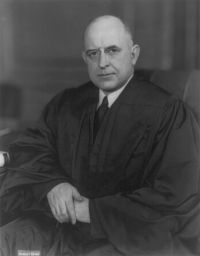
Ed F. McFaddin

Biographical details

Ed F. McFaddin,  Bates v. City of Little Rock (1958)

“ U.S., the Chief Justice of the United States wrote: 'There is no general authority to expose the private rights of an individual without justification'. In Sweeney vs. New Hampshire, the Court said: 'We do not now conceive of any circumstance wherein a State interest would justify an infringement upon these fields – freedom of speech and freedom of assembly'. It is our contention that the City of Little Rock has not shown that there is a compelling reason or a justifiable cause for requiring the defendant to produce the names of its members and the names of its contributors. ”
Source: Wikisource

Ed F. McFaddin,  Bates v. City of Little Rock (1958)

“ In the case at bar, the purpose of the ordinance is to determine the tax status of one seeking to claim immunity from occupation tax. The ultimate aim in NAACP v. Alabama was to stop the activities of NAACP; but in the case at bar, the disclosure of NAACP's list of members and contributors is a mere incident to see if legal taxation is being evaded. The ordinance here under attack does not single out NAACP and require information of it only: rather, the ordinance requires information of all organizations seeking exemption from privilege tax. ”
Source: Wikisource

Ed F. McFaddin,  Cole v. State (1949)

“ It is one where persons acting in concert have assembled in an attempt to prevent by force or violence some other person from engaging in a lawful occupation. Keeping in mind such idea of an "unlawful assemblage," we come to offense B. Since the State can prohibit the unlawful assemblage denounced in section 2-A3 (the constitutionality of which we have upheld) , [4] then it seems clear that the State can also constitutionally prohibit by § 2-B3 any person from promoting, encouraging or aiding "such unlawful assemblage." ”
Source: Wikisource

Get perspective with Kwize: daily news enlightened by great literature