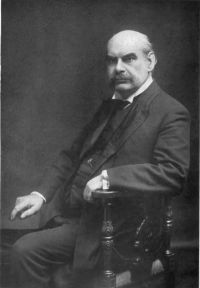
Edmund Gosse and Donald Francis Tovey

Biographical details

Edmund Gosse and Donald Francis Tovey 1911 Encyclopædia Britannica (1911)

To make them as rigid and forcible as the rhythms of a non-vocal music would produce an effect as intolerable to a Greek ear as a schoolboy’s worst jog-trotting scansion of poetry. We need not, then, imagine that the human sense of rhythm has suffered any mysterious change, when our best attempts at deciphering the extant fragments of ancient Greek music yield us a rhythm which scholars can explain by the structure of Greek verse, but which gives us no musical sense.
Source: Wikisource

Edmund Gosse and Donald Francis Tovey 1911 Encyclopædia Britannica (1911)

Rhythm in Verse.—Professor Jakob Minor has adduced a figure, valuable in helping us to realize what poetic rhythm is, when he remarks that to strike a bell twelve times, at exactly equal intervals, is to produce what may be called, indeed, a rhythmic effect, but not to awaken anything resembling the sensation of poetical rhythm. Into the idea of poetic rhythm enters an element of life, of pulse, of a certain inequality of time based upon an equality of tone. Rhythm ceases to be poetic, rhythm if it is mechanical or lifeless.
Source: Wikisource

Edmund Gosse and Donald Francis Tovey 1911 Encyclopædia Britannica (1911)

Accent, when translated into music, is a rhythmic sensation resembling the stress we put on the left foot in marching; while quantity rarely suggests any bodily movement at all, since it can correspond only to variations in the length of steps. Now in modern music a sense akin to that of bodily movement is of overwhelming importance. Changes of tempo, and of the grouping of musical beats, are incidents as obvious in their effect as changes in the pace of a running horse.
Source: Wikisource

Get perspective with Kwize: daily news enlightened by great literature