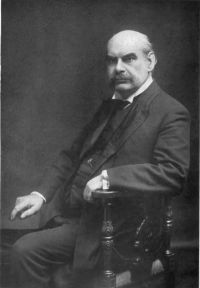
Frederick Corder

Biographical details

Portrait of Frederick Corder Frederick Corder,  A Dictionary of Music and Musicians (1900)

“ Every one, as we have already said, can understand a song or piece where a half-close occurs at each fourth and a whole close at each eighth bar, where it is expected; but when an uneducated ear is continually being disappointed and surprised by unexpected prolongations and alterations of rhythm, it soon grows confused and unable to follow the sense of the music. Quick music naturally allows—indeed demands—more variety of rhythm than slow, and we can scarcely turn to any Scherzo or Finale of the great composers where such varieties are not made use of. ”
Source: Wikisource

Portrait of Frederick Corder Frederick Corder,  A Dictionary of Music and Musicians (1900)

“ Where the accent of a piece is strictly binary throughout, composers, even to this day, appear to be often in doubt about the rhythm, time, and barring of their music. The simple and unmistakable rule for the latter is this: the last strong accent will occur on the first of a bar, and you have only to reckon backwards. If the piece falls naturally into groups of four accents it is four in a bar, but if there is an odd two anywhere it should all be barred as two in a bar. ”
Source: Wikisource

Portrait of Frederick Corder Frederick Corder,  A Dictionary of Music and Musicians (1900)

“ The great paucity of instrumental septets is probably owing to the fact that wind instruments are too full and powerful in tone to sound well with single strings, or even the piano. A striking instance of this incompatibility is accorded by Saint-Saëns' recently produced Septet for Piano, Strings and Trumpet; but, truth to say, whenever we hear even Beethoven's Septet or Schubert's Octet, we hare the impression of an exceedingly feeble orchestra, and yearn for the proper fulness of string power, albeit these works are not in the least orchestral. ”
Source: Wikisource

Get perspective with Kwize: daily news enlightened by great literature