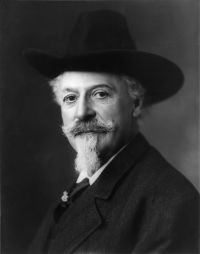
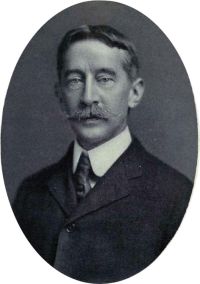
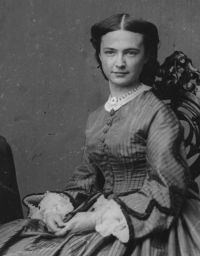
“ What shall I say of a young man like myself, fresh from the green East of New York and the Hudson River, landed expectant as just aroused from a dream of rare beauty, at this Benton City, Wyoming Territory? The dust, as fine as powder and as white, but shot through with the crimson of sunset, hung like a fog, amidst which swelled a deafening clamor from figures rushing hither and thither about the platform like half-world shades. A score of voices dinned into my ears as two score hands grabbed at my valise and shoved me and dragged me.“The Desert Hotel. Best in the West. This way, sir.” ”
Edwin L. Sabin
Biographical details

Edwin Legrand Sabin (1870–1952) was an American author celebrated for his boys’ adventure stories and historical accounts centered on the American West. His works, such as Kit Carson Days and General Crook and the Fighting Apaches, merged thorough research with vivid portrayals of frontier life, frequently drawing on interviews with historical figures and archival sources.
Concentrating on themes of exploration, conflict, and the harsh landscapes of the 19th century, Sabin’s extensive output for publishers like Thomas Y. Crowell Co. solidified his status as a chronicler of Western legends. Despite financial hardships during the Great Depression, his commitment to authenticity and his impact on children's literature remain substantial, illustrating a legacy defined by academic precision and storytelling skill.
Quotes by Edwin L. Sabin
 Edwin L. Sabin,
Buffalo Bill and the Overland Trail
Edwin L. Sabin,
Buffalo Bill and the Overland Trail
“ In the morning, when they once more halted to rest and feed the mules, the country was considerably rougher, with hills and fantastic rocks breaking the sagy, gravelly landscape. The white-topped wagons of emigrants and the smoke of their camp-fires were in sight, before and behind; and not far ahead a bull outfit were driving their bulls into the wagon corral to yoke up for the day’s trail. ”
Edwin L. Sabin,
Pluck on the Long Trail; Or, Boy Scouts in the Rockies
“ The fire did not arrive all at once, with a jump. Not where I was. A thin blue smoke, lazy and harmless, drifted through among the trees, and a crackling sounded louder and louder. Then there were breaths of hot air, as if a dragon was foraging about. Birds flew over, calling and excited, and squirrels raced along, and porcupines and skunks, and even worms and ants crawled and ran, trying to escape the dragon. A wind blew, and the timber moaned as if hurt and frightened. I felt sorry for the pines and spruces and cedars. They could not run away, and they were doomed to be burnt alive. ”
Edwin L. Sabin,
Gold Seekers of '49
“ Amidst ranches and huts and buildings of white wood and weather-beaten stone; on a broad level road crowded with people light and dark, and horses and mules and goats, and fringed with palms and bananas and plantains, oranges, cactuses, citrons, magnolias and acacias, crossing an old moat or wide ditch, through an arched gateway in a thick stone wall the belated little party entered famous Panama. Over the broad Pacific the sun hung low, and in the harbor, about a mile and a half from the end of a street which gave the view, lay a large black steamer with smoke welling from her stacks. ”
Edwin L. Sabin,
When You Were a Boy
“ You turn to Nature; surely Nature has the acumen to recognize that you have grown not at all, save, perhaps, in stature. But the sun burns, the rain wets, the snow chills—each uncompromising and austere. The pond that once stretched away like an ocean shrinks and shallows at your coming, till you can almost step from bank to bank; the once limitless wood, as wild and as romantic as the Carpathians, mischievously contracts so that you can see through from side to side; the highroad is dusty, and the paths refuse to lead, but are finished in a stride. ”
Edwin L. Sabin,
With George Washington into the wilderness
“ The muskets of White Thunder and Silver Heels had been thrust forward. The first Catawba stooped, to drink at the stream, when with a terrible whoop White Thunder fired. Aroas whooped and fired. Robert the Hunter whooped and sent an arrow whizzing. All the forest echoed to the whoops and the shots, as if a dozen men had attacked; and still whooping while they reloaded in a jiffy, drawing their hatchets White Thunder and Aroas ran boldly down. But the Catawbas had vanished; the last of them could just be heard bolting through the brush up the trail. ”
Edwin L. Sabin,
With Sam Houston in Texas
“ General Houston, in his whitish hat, his ragged stained black coat and snuff-colored trousers, cowhide boots and sword dangling in its rusted scabbard from his thong belt, was striding from cook fire to cook fire, among the messes.“Do you want to fight, men?” he was inquiring, right and left. “Shall we fight, or wait? I know the opinion of the officers; but what do you say?”Shrill cheers and hoarse shouts volleyed at him. Impulsive hands slapped him on the shoulder.“Fight! Fight!”“Hurrah!”“Lead us out, general!”Jim and Ernest joined in the uproar. The general was now smiling grimly. ”
Edwin L. Sabin,
With Carson and Frémont
“ There it lay, waiting, like a flat, prone dragon. There it lay, as the guide had asserted: arid, burning, white-hot, with occasional blackish ridges breaking its surface like scales, and with its fevered breath, like a mist, quivering above.“The great llanos—plains,” announced the guide, dramatically waving his hand. “They have no water, they have no grass; every animal that goes upon them dies.”“The Mohave Desert, I reckon it air,” said Kit Carson, meditatively surveying. “I crossed it twice, on that Californy trip, but the trail we made war lower down.” ”
Edwin L. Sabin,
Boys' Book of Indian Warriors and Heroic Indian Women
“ On the afternoon of December 19, this year 1675, the bold English and their allies struck the great fortified village at Sunke-Squaw. Out from the heat and smudge of the blazing wigwams fled Philip and Wetamoo and Canonchet, with their shrieking people, into the wintry swamp where the snowy branches of the cedars and hemlocks were their only refuge. Canonchet had lost a third of his nation; large numbers surrendered to the English; but, like his friend Philip, with his warriors who remained true he carried the war to the English themselves. ”
Edwin L. Sabin,
General Crook and the Fighting Apaches
“ On his back under the mesquite tree Jimmie was not thinking of Apaches. He was idly surveying the country—at the same time having an ear open to the musical tinkle of the bell-wether, who told him where the sheep were straying. And a delightful, dreamy outlook this was, over all those quiet miles of mountain and desert Arizona which only the Southern stage-line traversed, and which, so thinly settled by white people, the roving Apache Indians claimed as their own. ”
Edwin L. Sabin,
Beaufort Chums
“ The dog, having paid his respects, cuddled himself on the straw of the bows, in the sun, and there blinked, now and then expressing his ecstasy by a contented little sigh.“He knows we’ve got to keep him,” declared Hal. “We can’t throw him up into the loft again, and there’s no other place for him, except the boat.”“I’m glad of it, too,” asserted Ned. “Those people don’t deserve a dog, after the way they’ve treated him! Do they, pup?”The dog, hearing himself addressed, whimpered as if in memory of a dark past, and at the same time thumped his tail in celebration of a bright present. ”
Edwin L. Sabin,
Opening the West With Lewis and Clark
“ The United States had set the prairie afire!Hah! That they had! Did they set the prairie afire just to burn him, a boy? Had they known that he was watching them, and had that made them angry? The smoke increased rapidly—broadened and billowed. The prairie breeze puffed full and strong from the southeast, and the pungent odor of burning grasses swept across his quivering nostrils. The fire was pursuing him. It had cut off any retreat to the big river waters; it was swifter than an antelope, on his trail. Very cunning and cruel were those “’Nited States” men. ”
Edwin L. Sabin,
Boys' Book of Frontier Fighters
“ Led by the white savage, the Indians charged the gate with battering-ram logs; the log-carriers fell, but a hundred warriors stormed the palisade and tore with their knives and tomahawks and fingers at the pickets. From the loop-holes the long rifles cracked in a steady drum-fire. Every man and boy who could raise a muzzle aimed and fired and aimed and fired again. Every woman was busy—running bullets, filling powder flasks, loading rifles and leaning them ready for the eager, groping hands, and serving out water and food. ”
Edwin L. Sabin,
On the Plains with Custer
“ The creek-bed was too far; the earth around was flat and sandy and bald; but near at hand was a curious circular hollow, like a dimple in the brown face of the prairie. Crouching and skimming, Ned darted for it, and plunged in.This was a buffalo-wallow. In the beginning some old buffalo bull, tormented by flies, had pawed and horned and turned up the sod of a soft spot in the prairie, and there had taken a good roll. Other buffalo bulls had followed him, enlarging the hole as they enjoyed their mud-baths. ”
Edwin L. Sabin,
Gold Seekers of '49
“ Majestically the Panama glided into the harbor, and dropped anchor only a long stone's throw from the California. "Boom!" spoke her signal gun, and for her raced, again, the fleet of bumboats. Her rail was black-and-white with passengers, staring across at the passengers of the California. Men began to yell back and forth. "Where's your gold?" "Here! Where's yours?" and some of the Panama's passengers held up round little buckskin sacks; others slapped their shirt bosoms; and one man, amidst laughter, even held, in both hands, a large gunny sack which probably contained potatoes or yams. ”
Edwin L. Sabin,
With Sam Houston in Texas
“ Vigilance is the first duty of a soldier, and glory the proudest reward of his toils.You have patiently endured privations, hardships, and difficulties, unappalled; you have encountered odds of two to one of the enemy against you, and borne yourselves, in the onset and conflict of battle, in a manner unknown in the annals of modern warfare. While an enemy to your independence remains in Texas, the work is incomplete; but when liberty is firmly established by your patience and your valor, it will be fame enough to say, “I was a member of the army of San Jacinto.” ”
Edwin L. Sabin,
The other half
(1926)
“ In the long overland stretches the aviator pays scant attention to the dead epics that he violates with the drumming blast of his propeller when he bores through the atmosphere above those plains where the spirits still dance in little dust whirls that pivot and career with no breath of wind. ”
Edwin L. Sabin,
Boys' Book of Indian Warriors and Heroic Indian Women
“ The bullets flew like bees in the air, and whizzed by our ears like wind through the trees in winter. My warriors fell around me; I saw my evil day at hand. The sun rose dim on us in the morning, and at night it sank in a dark cloud, and looked like a ball of fire. That was the last sun that shone on Black-hawk. His heart is dead. He is now a prisoner to the white men; they will do with him as they wish. But he can stand torture and is not afraid of death. He is no coward. Black-hawk is an Indian. He has done nothing for which an Indian ought to be ashamed. ”
Edwin L. Sabin,
When You Were a Boy
“ Had Hen your mother, he would have been better cared for. But, then, households differ.At last you were off, your jacket, necessary as a portable depository, balanced with lunch, and the can of worms snugly fitted into a pocket, over the hard-boiled eggs; your mighty pole, become through many pilgrimages a veteran, sweeping the horizon; and your gallant old straw, ragged of contour and prickly with broken ends, courting, like some jaunty, out-at-the-elbow, swash-buckler cavalier, every passing breeze. ”
“ Our sorely laden train went swaying and pitching across the gaunt face of a high, broad plateau, bleak, hot, and monotonous in contour; underfoot the reddish granite pulverized by grinding tire and hoof, over us the pale bluish fiery sky without a cloud, distant in the south the shining tips of a mountain range, and distant below in the west the slowly spreading vista of a great, bared ocean-bed, simmering bizarre with reds, yellows and deceptive whites, and ringed about by battlements jagged and rock hewn. ”
Edwin L. Sabin,
Into Mexico with General Scott
(1920)
“ The gay lancers, bending low in their saddles, scudded like mad back into the sand hills and the brush, with another shell peppering their heels.“Hurrah! Hurrah!” Jerry cheered, for it looked as though that beach was going to be kept clear.He got such a box on the ear that it knocked him sprawling and set his head to ringing.“You shut up!” old Manuel scolded. “You little American dog, you! Your Americans are cowards. They dare not land and fight. They think to stand off out at sea and fight. The miserable gringos from the north! That’s the Mexican name for them: gringos. You understand?” ”
Edwin L. Sabin,
Boys' Book of Frontier Fighters
“ Border women, they, who well knew the uses of a rifle. A dummy cannon, of painted wood, had been mounted upon the flat roof of the commandant's quarters. But the Indian soon saw that it did not awaken. They laughed and jeered, and grew bolder. Within the fort all was a reek of powder-smoke; the stout pickets quivered to the pelting balls—every loop-hole was a target. Never did a garrison work harder; there was not an idle hand, for the wounded crawled about, helping. The Indians withdrew as quickly as they had come, and from the cover of the cabins shot furiously. ”
Edwin L. Sabin,
On the Plains with Custer
“ This is a story of Ned Fletcher, and the Seventh Regular Cavalry, United States Army, when upon the Western plains they followed the yellow-haired General Custer. Yet it is not all a story of fighting; for to be a good soldier does not mean that one must serve only to fight. Indeed, there are worthy battles other than those with lead and steel, horse and foot. Every earnest citizen is a good soldier. General Custer was as great in peace as in war; in his home as in the field, and he loved his home duties as much as he loved his other duties, which is token of a true man. ”
Edwin L. Sabin,
With Carson and Frémont
“ Barked Apache dogs; snorted Apache pony and stolen mule, stampeding here and there in the grayness. Spreading, on left and right, the charging teamsters overtook Oliver. Before, recumbent figures around the smouldering fires had up-leaped, throwing off blankets and robes, seizing weapons, hesitating, to discharge hasty bullet or arrow, and at thud of hoof, crack of rifle, and that terrible cry, “Kit Carson! Kit Carson!” half-naked to flee, through the grayness—scurrying across the level and scrambling amidst the rocky walls. ”
Edwin L. Sabin,
Buffalo Bill and the Overland Trail
“ Off to the side Lew Simpson and Wild Bill and little Billy and companions were shooting rapidly; the stranger hunters were shooting, behind; and now the reinforcements from the train were shooting and yelling, hoping to split the herd. Some of the buffaloes staggered and fell; others never hesitated or turned, but forged along as if blind and deaf. One enormous old bull seemed to bear a charmed life; he galloped right through the skirmish line; and the next thing that Davy, as excited as anybody, knew, the bull sighted him, and charged him. ”
Edwin L. Sabin,
General Crook and the Fighting Apaches
“ The Apache boy, who appeared to be fourteen or fifteen years old, was not more than five yards from him—standing there beside a giant cactus, naked except for a red cloth band about his forehead, and a whitish cotton girdle about his middle, with the broad ends hanging down before and behind, and regular Apache moccasins reaching like leggins half way up his thighs for protection against the brush: standing there, grinning, in his left hand a bow, in his right the wether’s bell! ”
Edwin L. Sabin,
When You Were a Boy
“ You and Hen talk in guarded tones, whilst your four eyes rove hither and thither, greedy to sight prey. But under-foot, stealthy though you fancy your advance, rustle the dried leaves, spreading afar the news of your passage; and hushed though you consider your voices, they penetrate into sharp ears attuned to catch the slightest alien sound. Eyes, sharper than yours, widen and wait.You would give the world to see a rabbit or a squirrel. You have just as much chance of seeing a rabbit or a squirrel as you have of seeing a hippopotamus. ”
Edwin L. Sabin,
Beaufort Chums
“ With the advent of the south winds and the steady dripping thaw, Ned’s ankle and Tom’s cough—keepsakes from that memorable Newton trip—rapidly disappeared; and the nearer ventured the ducks, the stronger felt the two boys. Together—Tom no longer Ned’s squire, but now, by virtue of that Christmas present, become his brother-at-arms—they haunted the levee, watching for the flight to set in and the ice to go out.Bob accompanied them. But he was not especially interested in ducks. Dread of gun forbade him to hunt them, alive; and instinct forbade him to gnaw the bones of them, dead. ”
“ The high desert stretched vastly, far, far, far before, behind, on either side, the parched gauntness of its daytime aspect assuaged and evanescent. For the moon, now risen, although on the wane, shed a light sufficient, whitening the rocks and the scattered low shrubs, painting the land with sharp black shadows, and enclosing us about with the mystery of great softly illumined spaces into which silent forms vanished as if tempting us aside. ”
Edwin L. Sabin,
Pluck on the Long Trail; Or, Boy Scouts in the Rockies
“ When the camp-fire smoke bends down, in the still air of midday or afternoon, a storm is apt to be brewing.When by night the stars are extra sharp and twinkle less than usual, overhead, but are dim around the horizon, a storm is apt to be brewing. ”
Edwin L. Sabin,
Boys' Book of Indian Warriors and Heroic Indian Women
“ There burst a distant rifle shot; it was instantly followed by a crackling volley, as from half a thousand rifles—and an answering heavier volley from the muskets of the militia. Struggling to don his blanket-coat he limped out, his gray queue ragged. The camp sprang to arms, for officers and men knew their business; but here came the militia like a drove of stampeded cattle, legging frantically for shelter from a horde of whooping, darting Indians. The militia dived through the lines of the regulars, into the very center of the camp, and for a short period all was chaos. ”
Edwin L. Sabin,
Gold Seekers of '49
“ In about an hour stop was made at the equally famous Island of Taboga—the most beautiful place, as seemed to Charley, in the world. It had a white beach; from the beach rose long slopes of green, shaded by bananas, palms, figs, plantains, oranges, limes—every kind of tropical growth. And these slopes were gayly colored with tiers of peak-roofed huts and houses, in pink and yellow and brown and blue and red. Along the beach were scores of white canoes. The people of Taboga, mostly negroes and mixed breeds, appeared to have nothing to do but loaf about and fish and eat and play. ”
Edwin L. Sabin,
On the Plains with Custer
“ The trail had left the stream, to cut across a big bend. The guides kept just at the head of the general’s horse. Whenever they came to a rise, one would creep forward and peer over. Seeing that the coast was clear, he would signal for the others to come on. Breathless work was this, and Ned’s heart thumped so that he feared he would be ordered to stay where he was. Now from the crest of a long brushy divide the Osage, reconnoitering, had put his hand to his brow, peering from under it. ”
Edwin L. Sabin,
With Carson and Frémont
“ A sentinel upon a sand-hill fired his gun to signal “Injuns! Injuns!” and rushed like wild-fire the word. Every teamster sprang to round up his picketed team, or to help collect the oxen; the sentries came in at a gallop; and men sped to help Oliver with the cavvy. Through the opening left in the circle of wagons poured men and animals, from outside to inside. And against the sunset glow could be descried a long file of black mounted figures, approaching at rapid trot.However, Captain Blunt, viewing them by spyglass, shouted thankfully:“Not Injuns, men! Whites! Look like traders.” ”
Edwin L. Sabin,
Buffalo Bill and the Overland Trail
“ Ever the trail unfolded on and on, sometimes skirting the shallow Platte, sometimes diverging a little to seek easier route. It traversed a country very unattractive, broken by the clayey buttes and by deep washes, and running off into wide, sandy plateaus and bottoms, rife with jack-rabbits, coyotes, prairie-dogs, antelope, and occasional buffalo. The rattlesnakes were a great nuisance; the men killed them with the whip lashes by neatly cutting off their heads as they coiled or sometimes shot them. And almost every morning somebody complained of a snake creeping into his warm blanket. ”
“ The Queen Hotel, the Big Tent, the rows of canvas, plank, tin, sheet metal, what-not stores, saloons, gambling dens, dance halls, human habitations—the blatant street and the station itself had subsided into this: a skeleton company of hacked and weazened posts, a fantastic outcrop of coldly blackened clay chimneys, a sprinkling of battered cans. The fevered populace who had ridden high 315 upon the tide of rapid life had remained only as ghosts haunting a potter’s field, and the turmoil of frenzied pleasure had dwindled to a coyote’s yelp mocking the twilight. ”
Edwin L. Sabin,
When You Were a Boy
“ Here, right before Maggie’s eyes, you boldly provision with two cookies and an apple. You reck not whether she sees, or not; the die is cast. You defiantly press on, straight out of the house, and through the back gate.The deed is done. You have gone. You are in the alley, and many a long year will elapse before that back gate again swings to your hand.You wish that the folks knew—but they don’t. Your heart aches for yourself; your going is so unheeded, the piteousness of it so wasted.You grow angry, and stiffen your neck. All right; they need not care, if they don’t want to. ”
Edwin L. Sabin,
Boys' Book of Indian Warriors and Heroic Indian Women
“ I am going back the long and sad trail to my people in the dark land. You make my feet heavy with gifts and my moccasins will grow old carrying them, yet the book is not among them. When I tell my poor blind people, after one more snow, in the big council, that I did not bring the book, no word will be spoken by our old men or by our young braves. One by one they will rise and go out in silence. My people will die in darkness, and they will go a long path to other hunting grounds. No white man will go with them, and no White Man's Book make the way plain. ”
Edwin L. Sabin,
Gold Seekers of '49
“ Beautiful was the coast of Mexico, hereabouts: a long strip of white beach where the blue surf broke; behind, vivid green hills, their bases dotted with white towns; and further behind, tremendous mountain-ranges, piercing the clouds. Acapulco seemed as hard to find as Chagres. The California acted as if she were going to butt right into the beach; and the passengers, crowded along the landside rails, eagerly waiting, could make out no harbor. Yet Acapulco was said to have the finest harbor between Panama and San Francisco ”
Edwin L. Sabin,
With Carson and Frémont
“ To-day we know that Frémont Peak, at the western border of Wyoming, is not the highest point of the Rocky Mountains; it is outranked by many another peak; but mere figures cannot always measure human endeavor, and in boldly assailing and overcoming this the highest, most kingly peak within their knowledge, there to plant their flag, Lieutenant John C. Frémont and companions show as fine quality of spirit as though the crest had been a thousand feet further. ”
“ Nevertheless there was a wild grandeur in the site, flooded all with crimson as the sun sank in the clear western sky beyond the Plains themselves, so that our plateau was still bathed in ruddy color when the Red Basin upon the one hand had deepened to purple and the white blotches of soda and alkali down in the Plains upon the other hand gleamed evilly in a tenuous gloaming.We had corralled adjacent to another tainted pond, of which the animals refused to drink but which furnished a little rank forage for them and an oasis for a half dozen ducks. ”
Edwin L. Sabin,
When You Were a Boy
“ You can hear, ahead of you, an enthusing medley of gay shrieks and cries and laughter.“Crickety!” you say to Hen, quickening the pace. “There’s a whole lot in already!”And you are not even undressed!On before, between the tree-trunks at your destination, you can glimpse, strewn over the sod or hanging from low branches, rejected and dejected garments—limp shirts, hickory, checked, tinted; stumpy trousers, dangling or down-flung. You descry the patchy blue of Snoopie Mitchell’s one-suspendered overalls; so you know that Snoopie is there. You know who else is there, too. ”
Edwin L. Sabin,
Gold Seekers of '49
“ Voices sounded constantly, echoing across the water; hammering never ceased; music floated—strains of violin and trumpet and piano! From the water-front clear back up the sides of the hills San Francisco was alive by night as by day. And on the hour all the vessels in the harbor struck their bells, in a great, melodious chime. Charley and his father and Mr. Grigsby stood long at the rail, as did the other passengers, gazing at the dim shore and its multitude of spectral lights, and talking. The whole ship seemed to be athrill with great expectations ”
Edwin L. Sabin,
With Carson and Frémont
“ Instantly the caravan was again in a frenzy of commotion. Teamsters curled their lashes and sent their mules into a lope, their oxen into a lumbering trot; loud rose a medley of exclamations, orders, rumbling of wheels. From behind little Oliver, who, his heart in his mouth, was shouting at his lazy cavvy, urging them forward (Oh, such a long way must he go!) , rode for him the rear-guard.“Quick! Roust these critters!” they bade, one to another, and helped him. The cavvy was forced into a trot. ”
“ I inquired.“As far as we can while the fog hangs. Then we must hide in the first good place. If they don’t strike our trail we’ll be all right.”The fog lingered in patches. From patch to patch we threaded, with many a glance over shoulder. But time was traveling faster. I marked her searching about nervously. Blue had already appeared above, the sun found us again and again, and the fog remnants went spinning and coiling, in last ghostly dance like that of frenzied wraiths.Now we came to a rough outcrop of red sandstone, looming ruddily on our right. ”
Edwin L. Sabin,
When You Were a Boy
“ The majority of them, however, use a track of their own—a shorter, slower track, off at one side. Poor things, condemned by fate to their own company and that of the smallest, timidest urchins, they pretend to have exciting times.They sit up straight, girls do, the ethics of society seeming to deny them the privilege of “belly-buster,” and on high sleds—nothing can be more ignominious than a “girl’s sled”—scraping and screaming, showing glimpses of red flannel petticoats as they prod with their heels, acting much like frightened hens scuttling through a yard they plough to their goal. ”
“ As far as Fremont the country along the railroad had been well settled with farms and unfenced cultivated fields. Now we had issued into the untrammeled prairies, here and there humanized by an isolated shack or a lonely traveler by horse or wagon, but in the main a vast sun-baked dead sea of gentle, silent undulations extending, brownish, clear to the horizons. ”
Edwin L. Sabin,
When You Were a Boy
“ The hill is ready. So are you. Your round turban-like cap is pulled firmly upon your head and over your ears, your red tippet (mother knit it) twice encircles your neck, crosses your breast, and is tied (by mother) behind in a double knot, your red double mittens (mother knit them and constantly darns them) are on your hands, and your legs and feet are in your stout copper-toed, red-topped boots. And your cheeks (mother kissed them) are red, too.Twitched by its leading-rope, follows you, like a loyal dog, your sled—a very fine sled, than which none is finer. ”
“ All the fatuousness that had led me astray to the lure of her blue eyes, upon the train and in hollow Benton, surged anew now—perhaps seasoned to present taste by my peppery defiance of Daniel. A man could do no less than bristle a little, under the circumstances; could do no less than challenge the torpedoes, like Farragut in Mobile Bay. Whether the game was worth the candle, I was not to be bullied out of my privileges by a clown swash-buckler who aped the characteristics of a pouter pigeon.Mr. Jenks was just going to bed under the wagon. ”
“ The Sioux had retired, mainly to sit dismounted in close circle, for a confab. Occasionally a young brave, a vidette, exuberantly galloped for us, dared us, shook hand and weapon at us, no doubt spat at us, and gained nothing by his brag.“What will they do next?” I asked.“I don’t know,” said she. “We shall see, though.”So we lay, gazing, not speaking. The sun streamed down, flattening the desert with his fervent beams until the uplifts cringed low and in the horizons the mountain peaks floated languidly upon the waves of heat. ”
Common terms
Works by Edwin L. Sabin
Boys' Book of Indian Warriors and Heroic Indian WomenDesert DustGeneral Crook and the Fighting ApachesWith Sam Houston in TexasLost with Lieutenant PikeWhen You Were a BoyWith George Washington into the wildernessBoys' Book of Frontier FightersGold Seekers of '49Buffalo Bill and the Overland TrailOn the Plains with CusterWith Carson and FrémontOpening the Iron TrailOpening the West With Lewis and ClarkInto Mexico with General ScottBeaufort ChumsEasy come, easy goThe other halfPluck on the Long Trail; Or, Boy Scouts in the Rockies