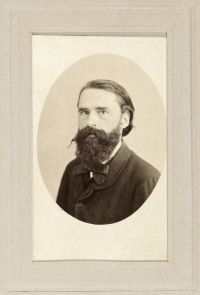
Ferdinand Gregorovius

Biographical details

Portrait of Ferdinand Gregorovius Ferdinand Gregorovius,  Wanderings in Corsica: Its History and Its Heroes…

“ Above yon black, primeval, granite hills hangs the red moon—no! it is the moon no longer, it is a great, pale, bloody, horrid head that hovers over the island of Corsica, and dumbly gazes down on it—a Medusa-head, a Vendetta-head, snaky-haired, horrible. He who dares to look on this head becomes—not stone, but an Orestes seized by madness and the Furies, so that he shall murder in headlong passion, and then wander from mountain to mountain, and from cavern to cavern, behind him the avengers of blood and the sleuthhounds of the law that give him no moment's peace. ”

Source: Gutenberg

Portrait of Ferdinand Gregorovius Ferdinand Gregorovius,  Wanderings in Corsica: Its History and Its Heroes…

“ Once, in the time of the beautiful Letitia, this house was alive with the busy stir of a numerous family, and brilliant with joyous hospitality. Now, it is like a tomb, and in vain you look around you for a single object on which fancy may hang associations with the history of its enigmatic inhabitants. The naked walls can tell no tale.
I do not know when the Casa Bonaparte was erected, but it can hardly be very old. It was built, no doubt, when the Genoese were supreme in the island, perhaps when Louis Quatorze was filling the world with his own fame, and with the fame of France.
”
Source: Gutenberg

Portrait of Ferdinand Gregorovius Ferdinand Gregorovius,  Wanderings in Corsica: Its History and Its Heroes…

“ I stood wonderstruck at such undreamt-of magnificence in scenery as the landscape presented—for at my feet I saw the hills, with all their burden of chestnut woods, sink towards the plain; the plain, like a boundless garden, stretch onwards to the strand; the streams of the Golo and Fiumalto wind through it to the glittering sea; and far on the horizon, the islands of Capraja, Elba, and Monte Chiato. The eye takes in the whole coast-line to Bastia, and southwards to San Nicolao; turning inland, mountain upon mountain, crowned with villages. ”
Source: Gutenberg

Get perspective with Kwize: daily news enlightened by great literature