George Stuart Fullerton

Biographical details

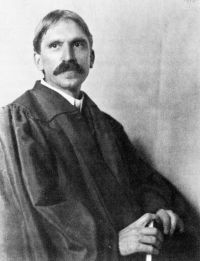
Portrait of George Stuart Fullerton George Stuart Fullerton,  An Introduction to Philosophy

“ How can we even have a consciousness of "crude" time, of apparent time, of duration in any sense of the word, when duration must be made up of moments no two of which can exist together and no one of which alone can constitute time? The past is not now, the future is not yet, the present is a mere point, as we are told, and cannot have parts. If we are conscious of time as past, present, and future, must we not be conscious of a series as a series when every member of it save one is nonexistent? Can a man be conscious of the nonexistent? ”
Source: Gutenberg

Portrait of George Stuart Fullerton George Stuart Fullerton,  A Handbook of Ethical Theory

“ We are born into a moral environment as into an all-embracing atmosphere. From the cradle to the grave, we walk with our heads in a cloud of exhortations and prohibitions. From our earliest years we have been urged to make decisions and to act, and we have been furnished with general maxims to guide our action. When, therefore, we approach the solution of a moral problem, we do not, as a rule, acutely feel our fitness to solve it, even though we may be judged quite unfit by others. ”
Source: Gutenberg

Portrait of George Stuart Fullerton George Stuart Fullerton,  An Introduction to Philosophy

“ Thus, when the philosopher lays before us an argument to prove that we must regard the only ultimate reality in the world as unknowable, and must abandon our theistic convictions, how shall we make a decision as to whether he is right or is wrong? May we expect that the day will come when he will be justified or condemned as is the astronomer on the day predicted for an eclipse? Neither the philosophy of Locke, nor that of Descartes, nor that of Kant, can be vindicated as can a prediction touching an eclipse of the sun. ”
Source: Gutenberg

Get perspective with Kwize: daily news enlightened by great literature