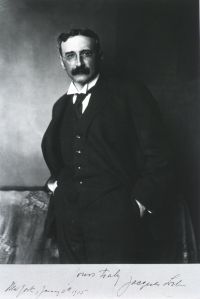
Jacques Loeb

Biographical details

Portrait of Jacques Loeb Jacques Loeb,  Popular Science Monthly (1912)

“ If our existence is based on the play of blind forces and only a matter of chance; if we ourselves are only chemical mechanisms—how can there be an ethics for us? The answer is, that our instincts are the root of our ethics and that the instincts are just as hereditary as is the form of our body. We eat, drink and reproduce not because mankind has reached an agreement that this is desirable, but because, machine-like, we are compelled to do so. ”
Source: Wikisource

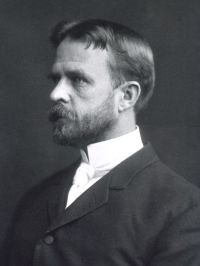
Portrait of Jacques Loeb Jacques Loeb,  The Organism as a Whole, from a Physicochemical Viewpoint

“ In this book an attempt is made to show that the unity of the organism is due to the fact that the egg (or rather its cytoplasm) is the future embryo upon which the Mendelian factors in the chromo­somes can impress only individual characteristics, probably by giving rise to special hormones and enzymes. We can cause an egg to develop into an organism without a spermato­zoön, but apparently we cannot make a spermato­zoön develop into an organism without the cytoplasm of an egg, although sperm and egg nucleus transmit equally the Mendelian characters. ”
Source: Gutenberg

Portrait of Jacques Loeb Jacques Loeb,  Popular Science Monthly (1912)

“ That a part is so constructed that it serves the "whole" is only an unclear expression for the fact that a species is only able to live—or to use Roux's expression—is only durable, if it is provided with the automatic mechanism for self-preservation and reproduction. If, for instance, warm-blooded animals should originate without a circulation they could not remain alive, and this is the reason why we never find such forms. The phenomena of "adaptation" cause only apparent difficulties since we rarely or never become aware of the numerous faultily constructed organisms which appear in nature. ”
Source: Wikisource

Get perspective with Kwize: daily news enlightened by great literature