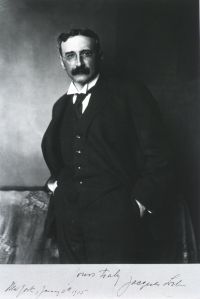
Jacques Loeb

Jacques Loeb

Summary

Portrait of Jacques Loeb Jacques Loeb,  Popular Science Monthly (1912)

“ If our existence is based on the play of blind forces and only a matter of chance; if we ourselves are only chemical mechanisms—how can there be an ethics for us? The answer is, that our instincts are the root of our ethics and that the instincts are just as hereditary as is the form of our body. We eat, drink and reproduce not because mankind has reached an agreement that this is desirable, but because, machine-like, we are compelled to do so. ”
Source: Wikisource

Portrait of Jacques Loeb Jacques Loeb,  Popular Science Monthly (1912)

“ Every animal originates from an egg and in the majority of animals a new individual can only then develop if a male sex-cell, a spermatozoon, enters into the egg. The question as to how a spermatozoon can cause an egg to develop into a new individual was twelve years ago still shrouded in that mystery which to-day surrounds the origin of life in general. But to-day we are able to state that the problem of the activation of the egg is for the most part reduced to physico-chemical terms. The egg is in the unfertilized condition a single cell with only one nucleus. ”
Source: Wikisource

Portrait of Jacques Loeb Jacques Loeb,  Popular Science Monthly (1912)

“ In many insects and in man the cells of the female have two sex-chromosomes. In a certain stage of the history of the egg one half of the chromosomes leaves the egg (in the form of the "polar-body") and the egg keeps only half the number of chromosomes. Each egg, therefore, retains only one X or sex-chromosome. In the male the cells have from the beginning only one X-chromosome and each primordial spermatozoon divides into two new (in reality into two pairs of) spermatozoa, one of which contains an X-chromosome while the other is without such a chromosome. ”
Source: Wikisource

Get perspective with Kwize: daily news enlightened by great literature