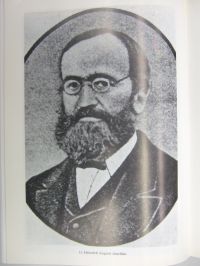
Norberto Romuáldez

Biographical details

Norberto Romuáldez Bisayan grammar and notes on Bisayan rhetoric and poetics and Filipino dialectology

The publication of a Bisayan grammar has been eagerly awaited by many. It has been desired by those who are interested simply in the study of a native dialect. It has been needed by all Americans who desire an acquaintance with the language of the people among whom they live in order that they may get into closer touch with the great mass of natives as yet unable to speak either Spanish or English.
Source: Gutenberg

Norberto Romuáldez Bisayan grammar and notes on Bisayan rhetoric and poetics and Filipino dialectology

The interrogative primitive formed; by these adverbs, has only two inflections: one which consists in the original root, and which is the past tense indicative; and the other which consists on the same root, its first syllable being doubled; this last form is for the present and future tenses, indicative. These three tenses are the only tenses that this conjugation has. The adverb “diín” is for the present and past tenses. The adverb “háin” is for the future. Thus:
The interrogative progressive only differs from the preceding one in that the particle pag precedes all of the inflections.
Source: Gutenberg

Norberto Romuáldez Bisayan grammar and notes on Bisayan rhetoric and poetics and Filipino dialectology

But when the verb “to be” is equivalent to the Spanish “estar”, i.e., when it represents state, situation, or contingent condition, it is then expressed by the particles pag, nag, ma, na added to the words which are predicate of “to be” in English. As
I shall be sorry: magmamabidò acó.
In cases where the verb “to be” needs to be represented by an independent word, the expressions “amo”, “asya”, “asáy”, “say” (which express identity, rather than a mere essence, substance or existence) are frequently employed. As [88]
In other cases, the verb “to be” is not translated into Bisayan.
Source: Gutenberg

Get perspective with Kwize: daily news enlightened by great literature