Paul Georg von Möllendorff

Biographical details

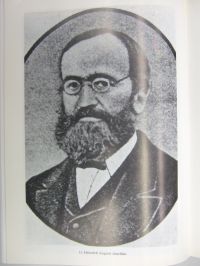
Portrait of Paul Georg von Möllendorff Paul Georg von Möllendorff A Manchu Grammar with Analysed Texts (1892)

Executed under the eyes of intelligent princes, they form a reliable expression of the meaning of the Chinese text and have therefore a right to acceptance equal to that enjoyed by commentaries of good writers. Manchu being infinitely easier to learn than Chinese, these translations are a great help towards obtaining a clear insight into Chinese syntax, and scholars like Stanislas Julien, who owed the remarkable precision in his renderings to his knowledge of Manchu, have repeatedly pointed this out.
Source: Wikisource

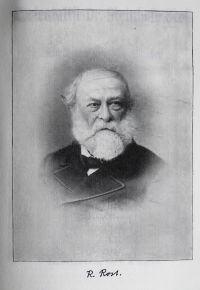
Portrait of Paul Georg von Möllendorff Paul Georg von Möllendorff A Manchu Grammar with Analysed Texts (1892)

There is a great variety of Interjections in Manchu: ai ah, ara alas, yaha ah, adada bravo, cibse hush, takasu stop, cu off, etc. A number of onomatopoetic interjections are used as verbs when followed by sembi (to speak) : kab snap, kab sembi to snap at; kanggūr kinggur helter-skelter, with sembi to fall with a great noise.
III. Syntax.
The position of words in a sentence is governed by the general rule, that every word precedes that by which it is governed. Thus the genitive stands before the noun on which it depends, e.g. boo i ejen the master of the house.
Source: Wikisource

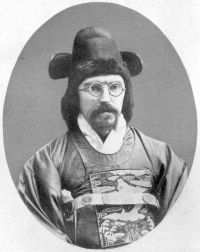
Portrait of Paul Georg von Möllendorff Paul Georg von Möllendorff A Manchu Grammar with Analysed Texts (1892)

All the Altaic languages show this peculiarity, the Turkish dialects the most, the Tungusic and Manchu the least. Within stems this harmony of vowels is of interest only to the philologist, but as most of the affixes in Manchu offer the choice between 2 or even 3 vowels (e.g. ha, ho, he; la, le; hon, hun, hūn) , a few rules are necessary to show which vowels should be used.
Stems terminating in a, e or o, take the same vowel in the affix: sula-ha left behind; mute-re being able to; tokto-ho fixed. Exceptions are given under “Verbs.”
Source: Wikisource

Get perspective with Kwize: daily news enlightened by great literature