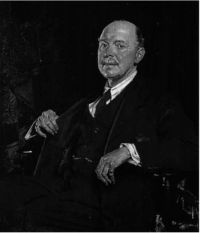
Sir Claude Phillips

Biographical details

Sir Claude Phillips The Earlier Work of Titian

If the Venetian master does not soar as high as Leonardo da Vinci or Michelangelo, those figures so vast, so mysterious, that clouds even now gather round their heads and half-veil them from our view; if he has not the divine suavity, the perfect balance, not less of spirit than of answering hand, that makes Raphael an appearance unique in art, since the palmiest days of Greece; he is wider in scope, more glowing with the life-blood of humanity, more the poet-painter of the world and the world's fairest creatures, than any one of these.
Source: Gutenberg

Sir Claude Phillips The Later Works of Titian

This is the greatest test of genius of the first order—to preserve undimmed in mature manhood and old age the gift of imaginative interpretation which youth and love give, or lend, to so many who, buoyed up by momentary inspiration, are yet not to remain permanently in the first rank. With Titian at this time supreme ability is not invariably illumined from within by the lamp of genius; the light flashes forth nevertheless, now and again, and most often in those portraits of men of which the sublime Charles V. at Mühlberg is the greatest.
Source: Gutenberg

Sir Claude Phillips The Earlier Work of Titian

Its beauty is all on the surface, while theirs stimulates the imagination of the beholder. The body with its strong, supple beauty, its unforced harmony of line and movement, with its golden glow of flesh, set off in the true Giorgionesque fashion by the warm white of the slender, diaphanous drapery, by the splendid crimson mantle with the changing hues and high lights, is, however, the most perfect poem of the human body that Titian ever achieved. Only in the late Venere del Pardo, which so closely follows the chief motive of Giorgione's Venus, does he approach it in frankness and purity.
Source: Gutenberg

Get perspective with Kwize: daily news enlightened by great literature