“ Yet bacteriology has its limitations. It is well to recognise this, for the new science has in some measure suffered in the past from over-zealous friends. It cannot achieve everything demanded of it, nor can it furnish a cause for every disease. It is a science fuller of hope than proved and tested knowledge. We are as yet only upon the threshold of the matter. As in the neighbouring realm of chemistry, it is to be feared that bacteriology has not been without its alchemy. ”
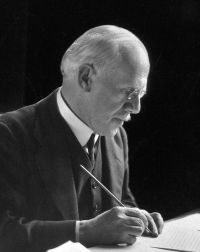
Sir George Newman
Biographical details
.jpg)
Sir George Newman (1870–1948), a British public health physician and Quaker, served as England’s first Chief Medical Officer and authored foundational works on the social determinants of health. His 1906 treatise Infant Mortality: a Social Problem revealed systemic causes of infant death, while texts like Bacteria (1900) examined microorganisms’ dual role in disease and industrial application.
A prolific writer, Newman connected public health to social reform, influencing policies through annual reports and lectures. His legacy persists in preventive medicine and the fusion of science with societal well-being.
Quotes by Sir George Newman
“ Not only in the diagnosis and treatment of disease, nor even in the various applications of preventive medicine, but in ever-increasing degree and sphere, micro-organisms are recognised as agents of utility or otherwise no longer to be ignored. They occur in our drinking water, in our milk supply, in the air we breathe. They ripen cream, and flavour butter. They purify sewage, and remove waste organic products from the land. They are the active agents in a dozen industrial fermentations. They assist in the fixation of free nitrogen, and they build up assimilable compounds. ”
“ The advance of science has been so rapid, and its place in modern life has become so dominant, that it is needful to revise continually the statement of its results, and to put these in a form that is intelligible and attractive. The man of science can himself be a specialist in one department only, yet it is necessary for him to keep abreast of scientific progress in many directions. The results of modern science are of use in nearly every profession and calling, and are an essential part of modern education and culture. ”
