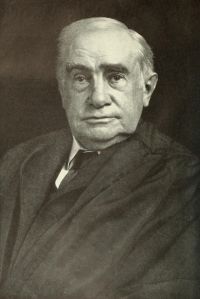
United States District Court for the District of Oregon

Biographical details

United States District Court for the District of Oregon State of Oregon v. City of Rajneeshpuram… (1984)

If the facts alleged in the State of Oregon's complaint are true, the court concludes that the potential injury to the anti-establishment principle of the first amendment by the existence and the operation of the City of Rajneeshpuram clearly outweighs the potential harm to defendants' free exercise of religion rights. To deny defendants the right to operate a city is the only means of achieving a compelling state and federal interest -- that of avoiding an establishment of religion.
Source: Wikisource

United States District Court for the District of Oregon State of Oregon v. City of Rajneeshpuram… (1984)

The court held that the State of Oklahoma's consent to be sued in its own courts did not create a waiver of its eleventh amendment immunity from suit in federal court:
The immunity may, of course, be waived. [Citation omitted] . When a state authorizes a suit against itself to do justice to taxpayers who deem themselves injured by any exaction, it is not consonant with our dual system for the Federal courts to be astute to read the consent to embrace Federal as well as state courts.
Source: Wikisource

United States District Court for the District of Oregon State of Oregon v. City of Rajneeshpuram… (1984)

Franchise Tax Board stands on the most fundamental level simply for the well-established proposition that a party cannot create federal court jurisdiction by anticipating a federal defense to a state law coercive action it could bring itself, with the added twist that this rule stands notwithstanding the fact that the declaratory judgment defendant also might be able to bring a coercive action that does arise under federal law.
Source: Wikisource

Get perspective with Kwize: daily news enlightened by great literature