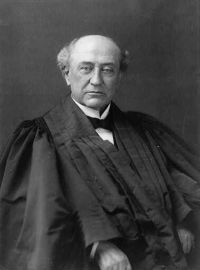
by the United States Circuit Court for the Southern District of Ohio

Biographical details

by the United States Circuit Court for the Southern District of Ohio McArthur v. Allen (1880)

Every one interested, if he choose to do so, may make himself a party to the record. Nothing is in question but the legal status of the will. That instrument is the res of the controversy, and in the absence of fraud all persons concerned, whether formally before the court as parties or not, are necessarily alike concluded by the verdict.
“Substantially this is a proceeding in rem, and the court cannot take jurisdiction of the subject-matter by fractions. The will is indivisible, and the verdict of a jury establishes it as a whole or wholly sets it aside.
Source: Wikisource

by the United States Circuit Court for the Southern District of Ohio United States v. Ambrose (1880)

I think the jurors drawn, whose names are put into the box, and who are selected and summoned to serve on the grand jury, must have the qualifications prescribed by law. But, on the other hand, I hold that the principles of a special demurrer are not to be applied in such cases; that ail that is required is an honest intention to conform to the statute, and to carry out its provisions in good faith.
Source: Wikisource

by the United States Circuit Court for the Southern District of Ohio United States v. Ambrose (1880)

I therefore think the declaration sufficient. It clearly alleges the failure to make the proper returns as a breach of the bond, and, as I have said, what follows may be treated as surplusage or as an allegation of the damages incurred. Of course, if there was no balance to turn over, the damages for failure to make returns would be merely nominal. If there were funds coming to the government their amount would be the measure of damages for a failure to make such returns as would have enabled the attorney general to make the proper designation.
Source: Wikisource

Get perspective with Kwize: daily news enlightened by great literature