Summary

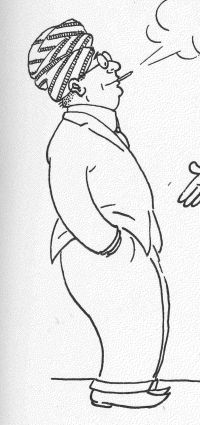
Portrait of Achmed Abdullah Achmed Abdullah The Swinging Caravan — Most Just Among Moslims (1925)

No privacy was here for either joy or despair. There was always the watching of in visible eyes, the listening of invisible ears. Twice while talking to Roger de Villemot he had heard a rustle of silken garments, a pattering of bare feet, a suppressed, staccato breathing.
And once he had heard the laughter of women, low, tinkly, malicious; doubtless his other two wives, he thought, Lella Meryem and Lella Nefoussa bent-Daoud.
Source: Wikisource

Portrait of Achmed Abdullah Achmed Abdullah The Swinging Caravan — Most Just Among Moslims (1925)

That's why I do not like to be reminded of Fathouma—and Sidi Abd el-Latif."
"You know his name?"
"Assuredly."
"But"—Roger de Villemot was bewildered—"I don't understand——"
"I am a just man," the other went on, "so just. Fathouma has given me a year or two of happiness. She spread silver and gold across the dust of my declining years. Thus I am grateful to her. But she is young and eager and hot-blooded. And so she deceives me. I know it. Perhaps she knows that I know. But you, Monsieur le Marquis, why should you know?"
Source: Wikisource

Portrait of Achmed Abdullah Achmed Abdullah The Swinging Caravan — Most Just Among Moslims (1925)

After he had arranged with some of his household for an alibi which would confound even the chilly logic of a French prosecuting attorney, he said quite casually to his negro pipe-servant:
"Tell me, Zaid! Where is the religion of robbers? Where is the forebearance of a fool? Where is the affection of a courtezan? Where is the truth of a liar?"
"The All-Merciful alone knows," Zaid mumbled piously.
"There are moments," smiled Sidi Mahmoud, "when I wonder if the All-Merciful does know."
Then, very calmly, he sent for Lella Fathouma, his youngest wife.
Source: Wikisource

Get perspective with Kwize: daily news enlightened by great literature