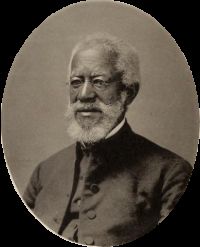
Alexander Crummell

Alexander Crummell

Summary

Portrait of Alexander Crummell Alexander Crummell The Future of Africa — Chapter I. (1862)

Again, the English language is characteristically the language of freedom. I know that there is a sense in which this love of liberty is inwrought in the very fibre and substance of the body and blood of all people; but the flame burns dimly in some races; it is a fitful fire in some others; and in many inferior people it is the flickering light of a dying candle. But in the English races it is an ardent, healthy, vital, irrepressible flame
Source: Wikisource

Portrait of Alexander Crummell Alexander Crummell The Future of Africa — Chapter I. (1862)

I do not forget that to give our small fraction of the race the advantages I have alluded to, a whole continent has been brought to ruin; the ocean has been peopled with millions of victims; whole tribes of men have been destroyed; nations on the threshold of civilization reduced to barbarism; and generation upon generation of our sires brutalized! No, my remarks, at best, are discordant; and I avoid collateral themes in order to preserve as much unity as possible, while endeavoring to set forth the worth and value of the English language.
Source: Wikisource

Portrait of Alexander Crummell Alexander Crummell The Future of Africa — Chapter I. (1862)

Indeed, is not the religion of Christ to he the great regenerating agent in all mental, as well as all spiritual things? Is not the church to take the lead in all things that are to elevate and dignify man? In any event, and by all means, do not let us go on in the dull, unthinking way we are now treading; and leave the minds of children and youth, in our families, unblessed by that pure speech and strong Anglo-Saxon thought, which come with the most impressive force, from the graceful mind, and the tender voice of cultivated womanhood.
Source: Wikisource

Get perspective with Kwize: daily news enlightened by great literature