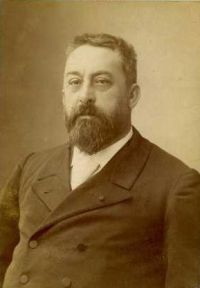
Alfred Nicolas Rambaud

Alfred Nicolas Rambaud

Summary

Portrait of Alfred Nicolas Rambaud Alfred Nicolas Rambaud,  History of Russia — Chapter 1 (1898)

“ The vegetation of the steppe, where men and flocks can hide themselves as in a forest, is often five, six, and even eight feet high. This monotonous steppe, unbroken except by the barrows that cover the bones of early races,—this steppe, which is an ocean of verdure in spring, but russet and burnt up in the autumn, is very dear to her children. ”
Source: Wikisource

Portrait of Alfred Nicolas Rambaud Alfred Nicolas Rambaud,  History of Russia — Chapter 1 (1898)

“ Russian rivers and history In a country so extensive and so destitute of seaboard as Russia, rivers have an immense importance, and with rivers Eastern Europe is well endowed. It is her watercourses which prevent Russia from being a continent closed and sealed, like Africa or Australia. In place of arms of the sea, she has great rivers which penetrate to her centre, and have sometimes almost the proportions of seas. In the level plains they have not the impetuous current of the Rhone, they flow peacefully through great beds cut in the sand or clay. ”
Source: Wikisource

Portrait of Alfred Nicolas Rambaud Alfred Nicolas Rambaud,  History of Russia — Chapter 1 (1898)

“ The rivers seem to hesitate at their rise between two opposite courses: some of them never make up their minds, like the sluggish Cheksna which connects the White Sea and the Volga. This interlacement of the water-system, which makes the northern Dwina, the Neva, the Niemen, and the southern Dwina mere prolongations of the Volga and the Dnieper, and puts the four Russian seas in unbroken communication, is in itself a sufficient explanation of the extent of the conquests and great commercial position of Novgorod the Great. ”
Source: Wikisource

Get perspective with Kwize: daily news enlightened by great literature