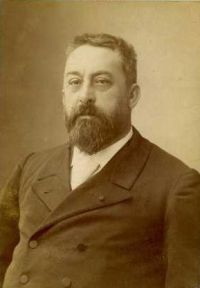
Alfred Nicolas Rambaud

Alfred Nicolas Rambaud

Summary

Portrait of Alfred Nicolas Rambaud Alfred Nicolas Rambaud,  History of Russia — Chapter 6 (1898)

“ In 1203 Kief was again sacked by the Polovtsi, whom the Olgovitches of Tchernigof had taken into their pay. On this soil, incessantly the prey of war and invasion, it was impossible to found a lasting order of things; it was impossible that a regular system of government should be established—that civilization should develop and maintain itself. Less richly endowed by nature, and less civilized, the Russia of the forests was at least more tranquil. ”
Source: Wikisource

Portrait of Alfred Nicolas Rambaud Alfred Nicolas Rambaud,  History of Russia — Chapter 6 (1898)

“ From the 11th to the 13th century, in passing from the basin of the Dneiper to the basin of the Volga, we can already watch the formation of Great and Little Russia. The principalities of Kief, Tchernigof, Novgorod-Severski, Riazan, Mourom, and Souzdal, situated on the side of the steppe with its devastating hordes, formed the frontier States, the Marches of Russia. ”
Source: Wikisource

Portrait of Alfred Nicolas Rambaud Alfred Nicolas Rambaud,  History of Russia — Chapter 6 (1898)

“ The fact that the wars that laid waste the country were civil wars, was a new proof of this unity. The different parts of Russia could not consider themselves strangers one to the other, when they saw the princes of Tchernigof and Souzdal taking up arms to prove which of them was the eldest, and which consequently had most right to the title of Grand Prince and the throne of Kief. ”
Source: Wikisource

Get perspective with Kwize: daily news enlightened by great literature