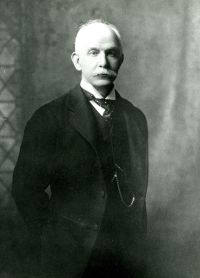
Brooks Adams

Brooks Adams

Summary

Portrait of Brooks Adams Brooks Adams The Law of Civilization and Decay… (1896 | notes)

In 1285, as the Latin kingdom in Syria was tottering towards its fall, Philip the Fair was crowned. Subtle, sceptical, treacherous, and cruel, few kings have left behind them a more sombre memory, yet he was the incarnation of the economic spirit in its conflict with the Church. Nine years later Benedetto Gaetani was elected pope: a man as completely the creation of the social revolution of the thirteenth century as Philip himself. Trained at Bologna and Paris, a jurist rather than a priest, his faith in dogma was so scanty that his belief in the immortality of the soul has been questioned.
Source: Wikisource

Portrait of Brooks Adams Brooks Adams The Law of Civilization and Decay… (1896 | notes)

Flotte had been killed at Courtray, and had been succeeded by the redoubtable Nogaret, whose grandfather was believed to have been burned as a heretic. With Nogaret Philip joined Sciarra Colonna, the bloodiest of the Italian nobles, and sent them together to Italy to deal with his foe. Boniface had made war upon the Colonnas, and Sciarra had been hunted like a wild beast. Flying disguised, he had been taken by pirates, and had preferred to toil four years as a galley-slave, rather than run the risk of ecclesiastical mercy by surrendering himself to the vicar of Christ.
Source: Wikisource

Portrait of Brooks Adams Brooks Adams The Law of Civilization and Decay… (1896 | notes)

Toward the close of the thirteenth century the fall of prices increased the weight of debt, while it diminished the power of the population to pay. On the other hand, as the system of administration became more complex, the cost of government augmented, and at last the burden became more than the laity could endure. Both England and France had a permanent deficit, and Edward and Philip alike turned toward the clergy as the only source of supply. Both kings met with opposition, but the explosion came in France, where Clairvaux, the most intractable of convents, appealed to Rome.
Source: Wikisource

Get perspective with Kwize: daily news enlightened by great literature