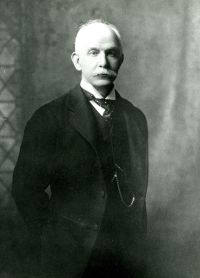
Brooks Adams

Brooks Adams

Summary

Portrait of Brooks Adams Brooks Adams The Theory of Social Revolutions… (1913 | notes)

The Constitution could hardly have been adopted or the government organized but for the personal influence of Washington, whose power lay in his genius for dealing with men. He lost no time or strength in speculation, but, taking the Constitution as the best implement at hand, he went to the work of administration by including the representatives of the antagonistic extremes in his Cabinet. He might as well have expected fire and water to mingle as Jefferson and Hamilton to harmonize.
Source: Wikisource

Portrait of Brooks Adams Brooks Adams The Theory of Social Revolutions… (1913 | notes)

The moment we consider the situation philosophically we perceive why using a court to control a coordinate legislature must, nearly inevitably, be sooner or later fatal to the court, if it asserts its prerogative. A court to be a fit tribunal to administer the municipal law impartially, or even relatively impartially, must be a small body of men, holding by a permanent and secure tenure, guarded from all pressure which may unduly influence them. Also they should be men of much experience and learned in the precedents which should make the rules which they apply stable and consistent.
Source: Wikisource

Portrait of Brooks Adams Brooks Adams The Theory of Social Revolutions… (1913 | notes)

Although our written Constitution was successful in its primary purpose of facilitating the consolidation of the Confederation, it has not otherwise inspired confidence as a practical administrative device. Not only has constant judicial interference dislocated scientific legislation, but casting the judiciary into the vortex of civil faction has degraded it in the popular esteem. In fine, from the outset, the American bench, because it deals with the most fiercely contested of political issues, has been an instrument necessary to political success.
Source: Wikisource

Get perspective with Kwize: daily news enlightened by great literature