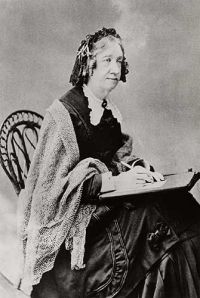
Catharine Esther Beecher

Catharine Esther Beecher

Summary

Portrait of Catharine Esther Beecher Catharine Esther Beecher An Essay on Slavery and Abolitionism

Now Abolitionists are before the community, and declare that all slavery is sin, which ought to be immediately forsaken; and that it is their object and intention to promote the immediate emancipation of all the slaves in this nation.
Now what is it that makes a man cease to be a slave and become free? It is not kind treatment from a master; it is not paying wages to the slave; it is not the intention to bestow freedom at a future time; it is not treating a slave as if he were free; it is not feeling toward a slave as if he were free.
Source: Gutenberg

Portrait of Catharine Esther Beecher Catharine Esther Beecher An Essay on Slavery and Abolitionism

South is a great sin, and that it ought immediately to cease. Suppose they accomplish this to the extent they hope,—so far as we have seen, the more the North is convinced, the more firmly the South rejects the light, and turns from the truth.
While Abolition Societies did not exist, men could talk and write, at the South, against the evils of slavery, and northern men had free access and liberty of speech, both at the South and at the North. But now all is changed. Every avenue of approach to the South is shut.
Source: Gutenberg

Portrait of Catharine Esther Beecher Catharine Esther Beecher An Essay on Slavery and Abolitionism

Where is the advocate of any measure that does not suffer sneers, ridicule, contempt, and all that tends to depreciate character in public estimation? Where is the partisan that is not attacked, as either weak in intellect, or dishonest in principle, or selfish in motives? And where is the man who is linked with any political party, that dares to stand up fearlessly and defend what is good in opposers, and reprove what is wrong in his own party?
Source: Gutenberg

Get perspective with Kwize: daily news enlightened by great literature