Summary

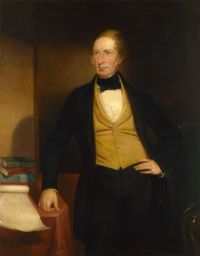
Portrait of Charles Sturt Charles Sturt Narrative of an Expedition into Central Australia

At six miles we struck another creek with a broad and grassy bed, on the banks of which we halted, at a small and muddy pool of water. The trees on this creek were larger than usual and beautifully umbrageous. It appeared as if coming from the N.E., and falling to the N.W. There were many huts both above and below our bivouac, and well-trodden paths from one angle of the creek to the other. All around us, indeed, there were traces of natives, nor can there be any doubt, but that at one season of the year or other, it is frequented by them in great numbers.
Source: Gutenberg

Portrait of Charles Sturt Charles Sturt Narrative of an Expedition into Central Australia

We stood, as it were, in the centre of barrenness. I feel it impossible, indeed, to describe the scene, familiar as it was to me. The dark and broken line of the Barrier Range lay behind us to the south; eastward the horizon was bounded by the hills I had lately visited, and the only break in the otherwise monotonous colour of the landscape was caused by the plains we had crossed before entering the pine forest. From the south-west round to the east northwards, the whole face of the country was covered with a gloomy scrub that extended like a sea to the very horizon.
Source: Gutenberg

Portrait of Charles Sturt Charles Sturt Narrative of an Expedition into Central Australia

From the brow of the last of these hills, the eye wanders over the dark and gloomy sea of scrub, known as the Murray belt, through which the traveller has to pass before he gains the bank of the river or the station at Moorundi. He descends direct upon the level plain over which he has to go, and after passing some pretty scenery on the banks of a creek close to which the road runs, and crossing an open interval, he enters the belt, through which it will take him four hours to penetrate.
Source: Gutenberg

Get perspective with Kwize: daily news enlightened by great literature