Summary

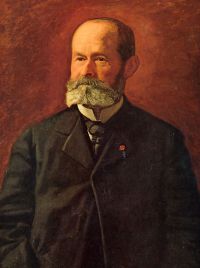
Portrait of Daniel G. Brinton Daniel G. Brinton The Battle and the Ruins of Cintla

Fig. 1.—Map of the Ruins of Cintla.
“The reason for this singular use of cement probably is that in the alluvial soil of this coast, no stones occur within a distance of fifty miles and more from the sea shore; stone implements, such as axes, chisels, grinding stones, obsidian flakes, etc., which are occasionally found, can have been introduced solely by trade. The pottery and the idols made of terra cotta show a high degree of perfection.
“Regarding the period down to which such earthenware was made, a broken vase disinterred from one of the mounds in my presence may give a clue.
Source: Gutenberg

Portrait of Daniel G. Brinton Daniel G. Brinton The Battle and the Ruins of Cintla

Among the relics is a large circular stone, “like a round table,” with figures in relief engraved on its sides, and with holes drilled in its surface, in which pegs or wooden nails are said to have been fitted.8-3 About ten miles north of this spot is another group of mounds on the left bank of the Rio de San Pablo y San Pedro. Doubtless many others exist unknown in the dense forests.
The Ruins of Cintla.—The ruins of Cintla were visited and surveyed by the late Dr. C. H. Berendt in March and April, 1869, and, so far as I know, neither before nor since have they been seen by any archæologist.
Source: Gutenberg

Get perspective with Kwize: daily news enlightened by great literature