Summary

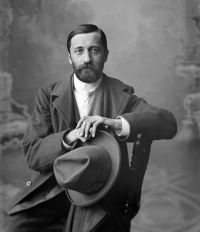
Portrait of Dmitry Sergeyevich Merezhkovsky Dmitry Sergeyevich Merezhkovsky The Life-Work of Flaubert, from the Russian of Merejowski

In the unity of the various portions of a work, in the every detail, in the harmony of the whole, Flaubert feels that "there is some inner essence, something in the nature of a divine force, something like an eternal principle." "For how otherwise would there exist any relation between the most exact and the most musical expression of thought?"
The sceptic who is not bound by any creed, but has spent his whole life in doubt and hesitation in face of the ideas of God, religion, progress, and scientific humanity, becomes pious and reverential when face to face with the question of art.
Source: Gutenberg

Portrait of Dmitry Sergeyevich Merezhkovsky Dmitry Sergeyevich Merezhkovsky The Life-Work of Flaubert, from the Russian of Merejowski

FLAUBERT I
Balzac in one of his novels gives utterance to the following thought: "Genius is a terrible disease. Every writer of genius cherishes in his heart a monster which devours all his emotions as soon as he gives birth to them. Which is to be the conqueror? Will the disease vanquish the man, or the man the disease? He must be a great man who can establish a perfect equilibrium between his genius and his character. Unless the poet be a giant, unless he be possessed of the shoulders of a Hercules, he must inevitably remain bereft of heart, or else bereft of talent."
Source: Gutenberg

Portrait of Dmitry Sergeyevich Merezhkovsky Dmitry Sergeyevich Merezhkovsky The Life-Work of Flaubert, from the Russian of Merejowski

Within a year's time he is, with half serious rhetoric and youthful enthusiasm, encouraging the same young friend to proceed with his own work. "Let us ever devote ourselves to our art, which, being more powerful than all nations, crowns, or rulers, holds, in virtue of its glorious diadem, eternal sway over the whole universe." When over forty years of age, and on the verge of the tomb, Flaubert repeats with even greater emphasis and audacity the same device: "L'homme n'est rien; l'œuvre est tout."—"Man is nothing; work is everything."
Source: Gutenberg

Get perspective with Kwize: daily news enlightened by great literature