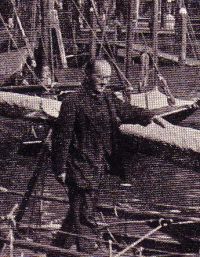
E. Keble Chatterton

E. Keble Chatterton

Summary

Portrait of E. Keble Chatterton E. Keble Chatterton Ships & Ways of Other Days

The rest is merely a narrative of collisions between ship and ship, with masts and sails falling, chains and grapnels straining, the hurling of stones and iron bars from the castle at the masthead, the felling of one another’s masts, the cutting adrift of the enemy’s halyards and shrouds, the heaving overboard (a favourite and regular habit in war) of every man and boy of the enemy they could lay their hands on, and finally victory to the English.
Source: Gutenberg

Portrait of E. Keble Chatterton E. Keble Chatterton Ships & Ways of Other Days

It is obvious that the growth of the arts of the sea—by which is meant ship designing and building, seamanship and navigation—can only occur among seafaring people. You cannot expect to find these arts prospering in the centre of a continent, but only along the fringe where land meets sea. And, similarly, where you find very little coast, or a very dangerous coast, or a more convenient land route than the sea, you will not find the people of that country taking to the awe-inspiring sea without absolute necessity.
Source: Gutenberg

Portrait of E. Keble Chatterton E. Keble Chatterton Ships & Ways of Other Days

It was not until the introduction of the log-line in the seventeenth century that a ship could tell with even approximate accuracy her daily run. For many a long year all the cunning Jews and Arabs, all the philosophers, the astronomers and physicians, all the cleverest men out of Portugal, Spain, Genoa, Venice, and the Balearic Isles had tried but failed to solve this proposition. And the coming of the perfect chronometer for finding the longitude was delayed even longer still.
Every modern deep-sea navigator is familiar with what is known as Great Circle Sailing.
Source: Gutenberg

Get perspective with Kwize: daily news enlightened by great literature