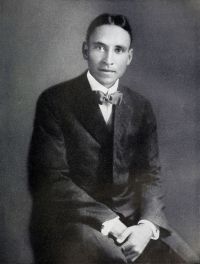
E. Newton Harvey

E. Newton Harvey

Summary

Portrait of E. Newton Harvey E. Newton Harvey The Nature of Animal Light

Whenever we shake a tube of luciferase, oxyluciferin and NH4SH, light will appear. When the tube is at rest it becomes dark. Even the merest touch is sufficient to agitate the tube contents, cause solution of oxygen and appearance of light. It is just as if we stimulate the tube to produce light and I believe the phenomenon has a deeper significance and a more fundamental similarity to the phenomena of stimulation than may at first appear. What more simple means of controlling a process can we think of than by admission or withdrawal of oxygen?
Source: Gutenberg

Portrait of E. Newton Harvey E. Newton Harvey The Nature of Animal Light

But, "would the light not extend farther were it bright enough to be seen?... if the light of the insect were as bright as that of the sun would it not extend equally far on either side of the spectrum?" "It is impossible to increase the intrinsic brilliancy by any optical device, but if it be impossible to make the light of the insect as bright as that of the sun, it is on the other hand quite possible to make the light of the sun no brighter than that of the insect ..."
Source: Gutenberg

Portrait of E. Newton Harvey E. Newton Harvey The Nature of Animal Light

He concludes "that as the bare Motion of the Lungs, without fresh air, contributes nothing to the life of the Animal, he being found to survive as well as when they were not moved as when they were; so it was not the Subsiding or Movelessness of the Lungs that was the immediate cause of death, or the stopping of the circulation of the Blood through the Lungs, but the Want of a sufficient Supply of fresh Air." The cause of death on collapse of the lungs could not be better stated to-day. Thus combustion, respiration and luminescence of flesh or wood were early recognized as related phenomena.
Source: Gutenberg

Get perspective with Kwize: daily news enlightened by great literature