Summary

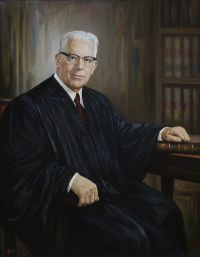
Portrait of Earl Warren Earl Warren Spano v. New York — Opinion of the Court

That confession was used to secure a verdict sending him to the electric chair.
Our Constitution guarantees the assistance of counsel to a man on trial for his life in an orderly courtroom, presided over by a judge, open to the public, and protected by all the procedural safeguards of the law. Surely a Constitution which promises that much can vouchsafe no less to the same man under midnight inquisition in the squad room of a police station.
Source: Wikisource

Portrait of Earl Warren Earl Warren Spano v. New York — Opinion of the Court

We find it unnecessary to reach that contention, for we find use of the confession obtained here inconsistent with the Fourteenth Amendment under traditional principles.
The abhorrence of society to the use of involuntary confessions does not turn alone on their inherent untrustworthiness. It also turns on the deep-rooted feeling that the police must obey the law while enforcing the law; that in the end life and liberty can be as much endangered from illegal methods used to convict those thought to be criminals as from the actual criminals themselves.
Source: Wikisource

Portrait of Earl Warren Earl Warren Spano v. New York — Opinion of the Court

The police were not therefore merely trying to solve a crime, or even to absolve a suspect. Compare Crooker v. State of California, supra, and Cicenia v. Lagay, supra. They were rather concerned primarily with securing a statement from defendant on which they could convict him. The undeviating intent of the officers to extract a confession from petitioner is therefore patent. When such an intent is shown, this Court has held that the confession obtained must be examined with the most careful scrutiny, and has reversed a conviction on facts less compelling than these.
Source: Wikisource

Get perspective with Kwize: daily news enlightened by great literature