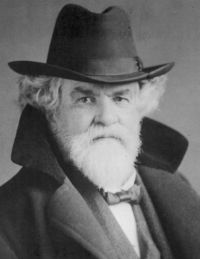
Edward Eggleston

Edward Eggleston

Summary

Portrait of Edward Eggleston Edward Eggleston The Beginners of a Nation

From all these fresh developments Puritanism gained in power and compactness, if it lost something of simplicity and spirituality. Standing for ultra-Protestantism, for good morals, for an ascetic Sabbath, for a high dogmatic orthodoxy, Puritanism could not but win the allegiance of the mass of the English people, and especially of the middle class. It was this new, compact, austere, dogmatic, self-confident Puritanism, when it had become a political as well as a religious movement, that obliterated Laud and Charles and set up the Commonwealth.
Source: Gutenberg

Portrait of Edward Eggleston Edward Eggleston The Beginners of a Nation

An age of romance and adventure. These erratic notions regarding America give one an insight into the character of the English people at the period of discovery and colony-planting. Credulity and the romantic spirit dwell together. The imagination in such an age usurped the place of discrimination, and the wonderful became the probable. The appetite for the marvelous fostered exaggeration; every man who had sailed in foreign seas thought it shame not to tell of wonders. The seventeenth century indeed betrayed a consciousness of its own weakness in a current proverb, "Travelers lie by license."
Source: Gutenberg

Portrait of Edward Eggleston Edward Eggleston The Beginners of a Nation

To men of his own time his tireless advocacy of American exploration and colony-planting must have seemed irksome hobby-riding. But he was the indispensable forerunner of colonization. "Your Mr. Hakluyt hath served for a very good trumpet," says Sidney. Believing in everything American as unwaveringly (p. 6) as if his soul's salvation depended on his faith, he believed in nothing more sublimely than in a passage to the "South Sea" or Pacific Ocean.
Source: Gutenberg

Get perspective with Kwize: daily news enlightened by great literature