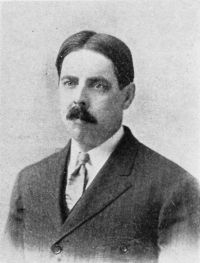
Edward L. Thorndike

Edward L. Thorndike

Summary

Portrait of Edward L. Thorndike Edward L. Thorndike Animal intelligence: Experimental studies (1911)

The facts of imitation in human and animal behavior are explainable by the laws of instinct, exercise and effect.
Some cases of imitation are undoubtedly mere instincts in which the situation responded to is an act by another of the same species. If the baby smiles at a smile, it is because of a special, inborn connection between that sight and that act,—he smiles at a smile for just the same reason that he draws down his mouth and wails at harsh words. At that stage of his life he does not imitate other simple acts. A man runs with a crowd for the same reason that he runs from a tiger.
Source: Gutenberg

Portrait of Edward L. Thorndike Edward L. Thorndike Animal intelligence: Experimental studies (1911)

It is most like what we feel when consciousness contains little thought about anything, when we feel the sense-impressions in their first intention, so to speak, when we feel our own body, and the impulses we give to it. Sometimes one gets this animal consciousness while in swimming, for example. One feels the water, the sky, the birds above, but with no thoughts about them or memories of how they looked at other times, or æsthetic judgments about their beauty; one feels no ideas about what movements he will make, but feels himself make them, feels his body throughout.
Source: Gutenberg

Portrait of Edward L. Thorndike Edward L. Thorndike Animal intelligence: Experimental studies (1911)

But I have tried to show that the fact that an animal reacts alike to a lot of things gives no reason to believe that it is conscious of their common quality and reacts to that consciousness, because the things it reacts to in the first place are not the hard-and-fast, well-defined ‘things’ of human life. What a ‘recept’ or ‘predominant’ really stands for is no thing which can be transformed into a notion of a quality by being labelled with a name. This easy solution of the problem of abstraction is impossible. A true idea of the problem itself is better than such a solution.
Source: Gutenberg

Get perspective with Kwize: daily news enlightened by great literature