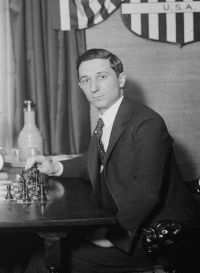
“ Unless a player be exceptionally gifted, he will only learn after years of practice, if at all, what may be termed “positional play.” For that, it is necessary to know how to open a game so as to lay the foundation for a favourable middle game, and how to treat a middle game, without losing sight of the possibilities of the end-game. It is hopeless to try to memorise the various openings which analysis have proved correct, for this empirical method fails as soon as the opponent swerves from the recognised lines of play. One must learn to recognise the characteristics of sound play. ”
Summary
Quotes from Chess Strategy (Edward Lasker)
“ Chess is a game of war—the various pieces represent the various kinds of forces: the pawns represent the infantry, the Knights take the place of cavalry, the Rooks do the work of heavy artillery, sweeping broad lines; the different ways in which the pieces move find a parallel in the topography of the theatre of war, in that the various battle-fields are more or less easy of access. ”
“ Speaking quite generally, common-sense will tell us that, in all operations on the chess-board, the main consideration for the defence will be to maintain that balance, and that there is only justification for an attack when it is possible to concentrate more forces on the strategic point than can be mustered by the defence. However, one very important point must not be neglected, though I did not touch upon it when discussing elementary combinations for fear of complicating matters for beginners: the balance between the contending forces is by no means established by their numerical equality. ”
“ When watching beginners you will frequently observe numberless moves by a peripatetic Queen, reckless incursions by a Knight into the enemy’s camp, and when the other pieces join in the fray, combination follows combination in bewildering sequence and fantastic chaos. Captures of pieces are planned, mating nets are woven, perhaps with two pieces, against a King’s position, where five pieces are available for defence. This unsteadiness in the first childish stages of development makes it very difficult for the beginner to get a general view of the board. ”
“ If one side or the other emerges from the conflict with some material gain, it will generally be possible to force a mate in the end-game, whilst if both sides have succeeded by careful play to preserve equality of material, a draw will generally ensue.It will be found a little later that a single pawn may suffice, with some few exceptions, to achieve a victory, and we shall adopt the following leading principle for all combinations, viz. loss of material must be avoided, even if only a pawn. It is a good habit to look upon every pawn as a prospective Queen. ”
“ We see here how the King’s position can be counterbalanced by the weakness of a pawn, and lead to a draw. If the White QBP was not isolated but standing, for instance, at QKt2, Black would be lost, as calculation easily shows.The strength or weakness of a pawn position, which, as we saw, had so deciding an influence in the end-game position just treated, is one of the most important factors in a game of chess, and should have full consideration in the middle game. A pawn, when isolated, is naturally weaker than when it is or can be protected by another. ”
“ The deeper study of the theory of the openings is of course a necessity to the student who wishes to become an expert, but the development of his judgment must precede it. To him Griffith & White’s admirable book, Modern Chess Openings, will be a perfect mine of information. There are thousands of variations, and in most of them the actual game in which they were first tried by masters is named, thus adding to the interest and value of the work. ”
“ A paramount factor is the mobility of such forces, and as soon as it is no longer one of the elementary cases of capture and recapture described previously, this factor must be taken into account in order to decide, on a general survey, whether there is a sufficient defence to an impending attack, or whether one’s own intended attack is likely to prevail. That mobility is the first and foremost consideration should be self-evident, since the relative value of the pieces can only make itself felt by their greater or lesser mobility. ”
“ A game is null and void if it is shown that a mistake was made in setting the board or men. The same applies when in the course of the game the position and number of pieces have been altered in a manner not in accordance with the proper course of play, and the latter cannot be re-constructed from the point where the error was made.If a player having the move touches one of his pieces he is under compulsion to move it; if he touches a hostile piece he must capture it, provided that the piece can be properly moved or captured in either case. ”
“ But when considering the form of a pawn position and that of the pieces, we cannot shut our eyes to the fact that pawn formation must necessarily be the dominant consideration in our mind. Pawn formation is of a more permanent character than that of the pieces, in consequence of the latter’s greater mobility. When we have made a rash move with a piece, to which our attacking disposition may have tempted us, we may still have a chance of retrieving the position by timely retreat. ”
“ The period required for such development largely depends upon the special gifts the learner may possess, but in the main the question of methods predominates. Most beginners do not trouble very much about any particular plan in their study of chess, but as soon as they have learnt the moves, rush into the turmoil of practical play. It is self-evident that their prospects under such conditions cannot be very bright. The play of a beginner is planless, because he has too many plans, and the capacity for subordinating all his combinations to one leading idea is non- existent. ”
“ This is explained by the attraction which combinations involving the action of many pieces have for them. They assume that exchanges, particularly of the Queens, make the games dull. Such ideas only prove that the beginner has not grasped the nature of chess, the essence of which is stern logic and uncompromising conclusions, and this demands the shortest and clearest way leading to a mate. To the strong player, able to play logically, logic will always be inseparable from beauty in chess. ”
“ My system of teaching differs from the usual ones, in that it sets down at the outset definite elementary principles of chess strategy by which any move can be gauged at its true value, thus enabling the learner to form his own judgment as to the manœuvres under consideration. In my opinion it is absolutely essential to follow such strategical principles, and I go so far as to assert that such principles are in themselves sufficient for the development and conduct of a correct game of chess. ”
“ Clearly the King cannot venture out into the field of operations until there has been an exchange of the majority of the pieces, so that there can be no danger of his being mated. As soon as a player has attained some advantage in material which ensures the victory in the end- game, he will try to bring about the end-game by exchanging pieces, for there the lines on which to push home his advantage are clearly set out. ”
“ It is instructive to watch how this very slight weakness created by Black’s advance of his pawns brings him into trouble. A White Knight settles down at his Q6, which is no longer guarded by the Black QBP, and paralyses the whole of Black’s game. Another factor in White’s superiority of position is the possession of the King’s file. The Black Rook cannot move until the King gets a loophole by a pawn move. As we have seen, such a pawn move often affords an entry to the opposing pieces. ”
“ A Rook standing behind an advanced pawn may support its further advance, or, if the pawn should be exchanged, might get an open file.The damage we wish to inflict on our opponent we must, of course, try to avoid ourselves. Thus we will not easily give up a centre pawn unless we can obtain some other advantage in doing so. This advantage may be, that in exchanging the centre pawn we open up lines of attack for our pieces, or that we are able to place one of our pieces in a commanding position in the centre of the board. ”
“ For quick development is of the utmost importance, and he who succeeds first in placing all his pieces, from their initial awkward positions, to such places as give them command of the greatest possible number of squares, has the better chance of concentrating a superior force on some important point.It follows that White, having the first move, is, so to speak, always morally justified in attacking, whilst Black should assume the defensive. ”
“ In castling, the King moves sideways to the next square but one, and the Rook to which the King is moved is placed on the square which the King has skipped over. Castling is only allowed if neither the King nor the Rook concerned have moved before, and if there is no piece between the Rook and King.Diagram 3 shows a position in which White has castled on the Queen’s side, and Black on the King’s side. Castling is not permitted if the King in castling must pass over a square attacked by a hostile piece. ”
“ When the players castle on different wings, there is always the danger of the opponent sacrificing pawns and opening up files for his Rooks and Q against the castled King. The game then assumes a wild character, and as matters are generally settled one way or another in the middle- game, end-game considerations, both with regard to number and position of pawns, can be disregarded. Experience has shown that the player who develops his attack first is likely to win, and that it is of little use to submit tamely to an assault of this kind without attempting a counter attack. ”
“ In nearly all end-games with pieces the King’s manœuvres used in pawn endings are of no avail, as far as opposition is concerned, as the advantage of opposition means that the opponent is forced to move his King, and as long as there are pieces on the board, such “forced move” positions are infrequent. ”
“ There are not many developing pawn moves to choose from. Apparently from the point of view of quick development only P-K4 and P-Q4 need be considered, since they free both Bishop and Queen, whilst other pawn moves liberate one piece only. Generally speaking it is only required to move two or three pawns to allow all pieces to be developed, and it is good, on principle, to make only such pawn moves in the opening, which are necessary for the development of pieces. ”
“ The student is not supposed to “learn” openings by heart, but to UNDERSTAND how the general principles of Chess Strategy are applied to any opening. Such knowledge can never be obtained from a tabulated analysis, but can only be arrived at by the application of common sense. If a player succeeds in winning in spite of an inferior opening, it only proves that subsequently he has played a stronger game than his opponent, who, after playing the opening according to the book, did not know how to proceed further. ”
“ It is frequently and erroneously thought that DOUBLED pawns as such are a weakness. Doubled pawns are weak when ISOLATED, for they cannot support each other. But if doubled pawns can be supported by a pawn on the next file they need not by any means be at a disadvantage against three united single pawns on the opposite side. For instance, in Diagram 64, if Black had a pawn at QKt3 instead of R2, White would have no winning chances. He could not attack the pawns, nor would any kind of manœuvres force a passed pawn through. ”
“ White rightly disdains the gain of the Knight’s Pawn, but prevents the exchange of Queens in developing a piece. He proves the superiority of his position much more convincingly in that way. Black must now lose yet another move to protect his Knight’s Pawn. ”
“ The large majority of chess players who would like to improve their game, have not the necessary opportunity of pitting themselves against players of master-strength, or at least of obtaining the desired instruction from personal intercourse with them. It is for such players that the present work is intended. The books on which the learner has to rely hardly ever serve his purpose, being mostly little more than a disjointed tabulation of numberless opening variations, which cannot be understood without preliminary studies, and consequently only make for confusion. ”
“ This explains why there is a tendency in modern master play to enforce the exchange of pieces, as soon as there is the slightest advantage sufficient to bring about one of the elementary end- game positions, in which the win can be forced. ”
“ A GAME of chess is played by two opponents on a square board consisting of sixty-four White and Black squares arranged alternately. The forces on each side comprise sixteen units, namely a King, a Queen, two Rooks, two Bishops, two Knights, and eight Pawns. All units move according to different laws, and the difference in their mobility is the criterion of their relative value and of the fighting power they contribute towards achieving the ultimate aim, namely, the capture of the opposing King. ”
“ While White’s development is easy and natural, Black has difficulty in finding good places for his King’s side pieces. The game can proceed generally speaking on the lines of the French defence. Only Black can hardly attack White’s centre with P-B3, since the Pawn at K3 would be weak in the absence of the Queen’s Bishop. On the other hand, Black would be a move behind with an attack on the Queen’s side, since to reach QB4 his pawn would have made two moves instead of one as in the French defence. ”
“ As Black’s KKt is only supported twice, and there is no chance of bringing up more forces for its defence, Black must undertake something to provide against the threatened onslaught.The most natural plan is to develop the QB at K3, from where it can be exchanged for the Knight should Kt-Q5 be played. The doubled pawn, which White could force by exchanging the Bishops, is in no way detrimental to Black’s game. On the contrary, the opening of the file for the Rook, with the attendant chance of playing P-Q4 supported by the doubled pawn, gives Black the advantage. ”
“ We will now turn our attention to positions in which the pawns opposed on each wing are of equal number and no passed pawn can be forced through. Everything depends on the relative position of the Kings. The deciding factor in valuing the King’s position is whether pawn moves are possible, or whether they are already entirely or nearly exhausted, so that only manœuvres by the King are possible. ”
“ The pawns only move straight forward, one square at a time, except at their first move, when they have the option of moving two squares. In contrast to the pieces, the pawns do not capture in the way they move. They move straight forward, but they capture diagonally to the right and left, again only one square, and only forward. Therefore a pawn can only capture such pieces or pawns as occupy squares of the same colour as the square on which it stands. ”
Common terms
Similar works
Chess and Checkers : the Way to Mastership…Chess Fundamentals (José Raúl Capablanca…The blue book of chess (Howard Staunton…How to Play Chess (Charlotte Boardman Rogers…Collier's Cyclopedia of Commercial and Social Information…1911 Encyclopædia Britannica, Volume 6…The Game of Go (Arthur Smith)The Game of Go: The National Game of Japan…Chess Department — Problem I
