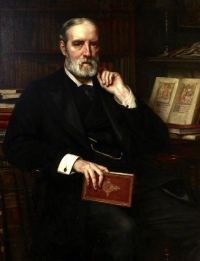
Edward Maunde Thompson

Edward Maunde Thompson

Summary

Portrait of Edward Maunde Thompson Edward Maunde Thompson 1911 Encyclopædia Britannica (1910)

From the 16th century onward, we enter the period of modern history, and autograph documents of all kinds become plentiful. And yet in the midst of this plenty, by a perverse fate, there is in certain instances a remarkable dearth. The instance of Shakespeare is the most famous. But for three signatures to the three sheets of his will, and two signatures to the conveyances of property in Blackfriars, we should be without a vestige of his handwriting. For certain other signatures, professing to be his, inscribed in books, may be dismissed as imitations.
Source: Wikisource

Portrait of Edward Maunde Thompson Edward Maunde Thompson 1911 Encyclopædia Britannica (1911)

But in an inquiry into the history of the documents of the middle ages in Europe we do not begin with primitive forms. Those ages inherited the documentary system which had been created and developed by the Romans; and, imperfect and limited in number as are the earliest surviving charters and diplomas of European medieval history, they present themselves to us fully developed and cast in the mould and employing the methods and formulae of the earlier tradition.
Source: Wikisource

Portrait of Edward Maunde Thompson Edward Maunde Thompson 1911 Encyclopædia Britannica (1910)

But, when we now speak of autographs and autograph collections, we use such terms in a restricted sense and imply documents or signatures written by persons of some degree of eminence or notoriety in the various ranks and professions of life; and naturally the only early autographs in this sense which could be expected to survive are the subscriptions and signatures of royal personages and great officials attached to important public deeds, which from their nature have been more jealously cared for than mere private documents.
Source: Wikisource

Get perspective with Kwize: daily news enlightened by great literature