Summary

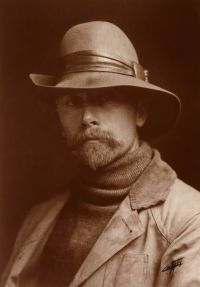
Portrait of Edward S. Curtis Edward S. Curtis The North American Indian, Vol…

From the camp where they have passed the winter they take to the trails which lead to the mescal hills.
For some hours after leaving the huts on White river the path leads across the hot, dusty desert; then it reaches the rim of White river cañon and follows its edge so closely that a pebble tossed from the saddle would drop into the torrent more than a thousand feet below. How musical the roar of the stream, and how cool its waters look! As the trail passes some especially dizzy spot the Indian women lean away from the sheer edge in fear. For miles the trail traverses the bluff.
Source: Gutenberg

Portrait of Edward S. Curtis Edward S. Curtis The North American Indian, Vol…

In this clear, rare atmosphere the far distant horizon is the only limit to his vision. Just below, a mile or so away, may perhaps be seen the smoke from a group of half a dozen hogáns. Miles beyond is another group, and still beyond another, and so throughout the sweep of vision. These people and their life are delightfully Indian, but slightly influenced by the white man's ways. As the chief human touch of the great southwestern desert the Navaho are the artist's joy, and as a subject for the ethnologist their ceremonial life furnishes limitless material for study.
Source: Gutenberg

Portrait of Edward S. Curtis Edward S. Curtis The North American Indian, Vol…

The first group of grotesquely masked men is ready by nine or ten o'clock; they file into the dance enclosure led by Hasché̆ltĭ, their naked, clay-painted bodies glinting in the firelight. While wearing masks the performers never speak in words; they only sing or chant. To address one in conversation would incur the displeasure of the gods and invite disaster. Time is kept by the basket drum and the rhythm of the singing.
Source: Gutenberg

Get perspective with Kwize: daily news enlightened by great literature