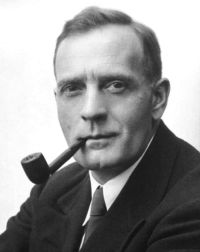
Edwin Hubble

Edwin Hubble

Summary

Portrait of Edwin Hubble Edwin Hubble,  Extra-galactic nebulae (1926)

“ The number of nebulae of known distance is too small to serve as a basis for estimates of the range in absolute magnitude among nebulae in general. Further information, however, can be derived from a comparison of total apparent magnitudes with apparent magnitudes of the brightest stars involved, on the reasonable assumption, supported by such evidence as is available, that the brightest stars in isolated systems are of about the same intrinsic luminosity. ”
Source: Gutenberg

Portrait of Edwin Hubble Edwin Hubble,  Extra-galactic nebulae (1926)

“ Elliptical nebulae have accordingly been designated by the symbol “E,” followed by a single figure, numerically equal to the ellipticity (a – b) /a with the decimal point omitted. The complete series is E0, E1, ..., E7, the last representing a definite limiting figure which marks the junction with the spirals.
The frequency distribution of ellipticities shows more round or nearly round images than can be accounted for by the random orientation of disk-shaped objects alone. It is presumed, therefore, that the images represent nebulae ranging from globular to lenticular, oriented at random.
”
Source: Gutenberg

Portrait of Edwin Hubble Edwin Hubble,  Extra-galactic nebulae (1926)

“ Barred spirals.—In the normal spiral the arms emerge from two opposite points on the periphery of the nuclear region. There is, however, a smaller group, containing about 20 per cent of all spirals, in which a bar of nebulosity extends diametrically across the nucleus. In these spirals, the arms spring abruptly from the ends of this bar. These nebulae also form a sequence, which parallels that of the normal spirals, the arms apparently unwind, the nuclei dwindle, the condensations form and work inward. ”
Source: Gutenberg

Get perspective with Kwize: daily news enlightened by great literature