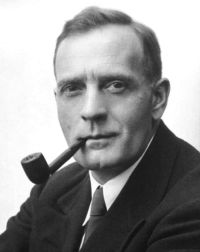
Edwin Hubble

Biographical details

Portrait of Edwin Hubble Edwin Hubble,  Photographic investigations of faint nebulae (1920)

“ Even then an exception must be granted for possible gaseous nebulae which appear stellar in the telescope, but whose true nature is revealed by the spectroscope. It may well be that they differ in kind and do not form a unidirectional sequence of evolution. Some at least of the great diffuse nebulosities, connected as they are with even naked-eye stars, lie within our stellar system; while others, the great spirals, with their enormous radial velocities and insensible proper motions, apparently lie outside our system. ”
Source: Gutenberg

Portrait of Edwin Hubble Edwin Hubble,  Extra-galactic nebulae (1926)

“ The number of nebulae of known distance is too small to serve as a basis for estimates of the range in absolute magnitude among nebulae in general. Further information, however, can be derived from a comparison of total apparent magnitudes with apparent magnitudes of the brightest stars involved, on the reasonable assumption, supported by such evidence as is available, that the brightest stars in isolated systems are of about the same intrinsic luminosity. ”
Source: Gutenberg

Portrait of Edwin Hubble Edwin Hubble,  Photographic investigations of faint nebulae (1920)

“ The study of nebulae is essentially a photographic problem for cameras of wide angle and reflectors of large focal ratio. The photographic plate presents a definite and permanent record beside which visual observations lose most of their significance. Perhaps the one field left for the older method is the measurement of sharp nuclei deeply enshrouded in nebulosity. New nebulae are now but rarely seen in the sky, although an hour’s exposure made at random with a large reflector has more than an even chance of adding several small faint objects to the rapidly growing list of those already known. ”
Source: Gutenberg

Get perspective with Kwize: daily news enlightened by great literature