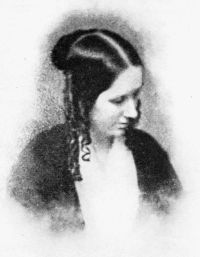
Elizabeth Cabot Agassiz

Elizabeth Cabot Agassiz

Summary

Portrait of Elizabeth Cabot Agassiz Elizabeth Cabot Agassiz The Atlantic Monthly (1866)

When we reached the landing, the gold and rose-colored clouds were fading into soft masses of white and ashen gray, and moonlight was taking the place of sunset. As we went up the green slope to the sitio, a dance on the grass was proposed, and the Indian girls formed a quadrille; for thus much of outside civilization has crept into their native manners, though they throw into it so much of their own characteristic movements that it loses something of its conventional aspect.
Source: Wikisource

Portrait of Elizabeth Cabot Agassiz Elizabeth Cabot Agassiz The Atlantic Monthly (1866)

The sun had long set as we issued from the little river, and the Rio Negro, where it opens broadly out into the Amazons, was a sea of silver. The boat with the music presently joined our canoe; and we had a number of the Brazilian modinhas, as they call them,—songs which seem especially adapted for the guitar and moonlight. These modinhas have quite a peculiar character. They are little, graceful, lyrical snatches of song, with a rather melancholy cadence; even those of which the words are gay not being quite free from this undertone of sadness.
Source: Wikisource

Portrait of Elizabeth Cabot Agassiz Elizabeth Cabot Agassiz The Atlantic Monthly (1866)

Every now and then an Indian girl would come in to rest for a while, take a nap in a hammock, and then return to the dance. When we first arrived in South America, we could hardly have slept soundly under such circumstances; but one soon becomes accustomed, on the Amazons, to sleeping in rooms with mud floors and mud walls, or with no walls at all, where rats and birds and bats rustle about in the thatch over one's head, and all sorts of unwonted noises in the night remind you that you are by no means the sole occupant of your apartment.
Source: Wikisource

Get perspective with Kwize: daily news enlightened by great literature