Summary

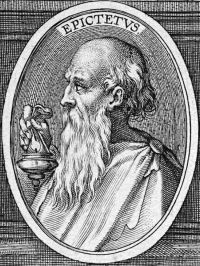
Portrait of Epictetus Epictetus Epictetus, the Discourses as reported by Arrian… (1925)

Arouse in me an eagerness for it. Just as suitable grass when shown to the sheep arouses in it an eagerness to eat, whereas if you set before it a stone or a loaf of bread, [1] it will not be moved to eat, so we have certain moments of natural eagerness for speech also, when the suitable hearer appears, and when he himself stimulates us. But when the would-be hearer by our side is like a stone, or grass, how can he arouse desire in the breast of a man?
Source: Wikisource

Portrait of Epictetus Epictetus Epictetus, the Discourses as reported by Arrian… (1925)

Who has the charge of nations and sustains
Such mighty cares, [2]
and for the sake of a paltry damsel engage in a fist-fight with the greatest warrior among your allies, a man whom you ought to honour and protect in every way? And do you sink below the level of an elegant high priest who treats the noble gladiators with all respect? [3] Do you see the sort of thing that ignorance of what is expedient leads to?
"But I too am rich." You are not, then, richer than Agamemnon, are you? "But I am also handsome." You are not, then, handsomer than Achilles, are you?
Source: Wikisource

Get perspective with Kwize: daily news enlightened by great literature