Summary

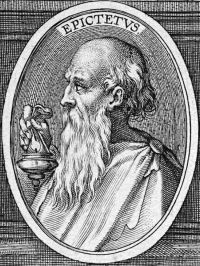
Portrait of Epictetus Epictetus The Encheiridion of Epictetus (1881)

If, having considered these circumstances, you are still in the mind to enter for the Olympic prize, then do so. But without consideration, you will turn from one thing to another like a child, who now plays the wrestler, now the flute-player, now the gladiator, then sounds the bugle-call, or declaims like an actor; and so you too will be first an athlete, then a gladiator, then an orator, then a philosopher, and nothing with your whole soul; but as an ape you will mimic every sight you see, and flatter yourself with one thing after another.
Source: Wikisource

Portrait of Epictetus Epictetus The Encheiridion of Epictetus (1881)

For this crippled slave of Hierapolis had undoubtedly a brightness and energy of intellect, a buoyancy of spirit, an instinctive sense of what is excellent in action, an instinctive aversion for all facile and unreal thinking such as few of the world's teachers before or after him have possessed. He has the rare and important characteristic that he deserves to be read as much for what is not in him as for what is.
Source: Wikisource

Portrait of Epictetus Epictetus The Encheiridion of Epictetus (1881)

When you see a man honoured above others, or mighty in power, or otherwise in high repute, look to it that you esteem him not blessed, being rapt-away by the phantasm. For if Good, in its essence, be in those things which depend upon ourselves, then there is no place for jealousy or envy, and you yourself will not wish to be a general, or a prince, or a consul–but to be free.
Source: Wikisource

Get perspective with Kwize: daily news enlightened by great literature