“ This instant, then, think yourself worthy of living as a man grown up and a proficient. Let whatever appears to be the best be to you an inviolable law. And if any instance of pain or pleasure, glory or disgrace, be set before you, remember that now is the combat, now the Olympiad comes on, nor can it be put off; and that by one failure and defeat honor may be lost or—won. Thus Socrates became perfect, improving himself by everything, following reason alone. And though you are not yet a Socrates, you ought, however, to live as one seeking to be a Socrates. ”
Summary
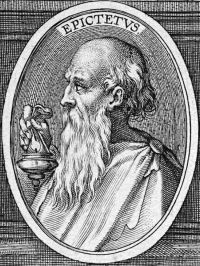
“The Enchiridion”, is a work by Epictetus. It explores elements such as philosopher, Stoic and externals.
Quotes from The Enchiridion (Epictetus)
“ You can be unconquerable if you enter into no combat in which it is not in your own power to conquer. When, therefore, you see anyone eminent in honors or power, or in high esteem on any other account, take heed not to be bewildered by appearances and to pronounce him happy; for if the essence of good consists in things within our own power, there will be no room for envy or emulation. But, for your part, do not desire to be a general, or a senator, or a consul, but to be free; and the only way to this is a disregard of things which lie not within our own power. ”
“ When you have reckoned up all this, if your inclination still holds, set about the combat. Otherwise, take notice, you will behave like children who sometimes play wrestlers, sometimes gladiators, sometimes blow a trumpet, and sometimes act a tragedy, when they happen to have seen and admired these shows. Thus you too will be at one time a wrestler, and another a gladiator; now a philosopher, now an orator; but nothing in earnest. Like an ape you mimic all you see, and one thing after another is sure to please you, but is out of favor as soon as it becomes familiar. ”
“ With regard to whatever objects either delight the mind or contribute to use or are tenderly beloved, remind yourself of what nature they are, beginning with the merest trifles: if you have a favorite cup, that it is but a cup of which you are fond of—for thus, if it is broken, you can bear it; if you embrace your child or your wife, that you embrace a mortal—and thus, if either of them dies, you can bear it. ”
“ Men are disturbed not by things, but by the views which they take of things. Thus death is nothing terrible, else it would have appeared so to Socrates. But the terror consists in our notion of death, that it is terrible. When, therefore, we are hindered or disturbed, or grieved, let us never impute it to others, but to ourselves—that is, to our own views. It is the action of an uninstructed person to reproach others for his own misfortunes; of one entering upon instruction, to reproach himself; and one perfectly instructed, to reproach neither others nor himself. ”
“ Be not elated at any excellence not your own. If a horse should be elated, and say, “I am handsome,” it might be endurable. But when you are elated and say, “I have a handsome horse,” know that you are elated only on the merit of the horse. What then is your own? The use of the phenomena of existence. So that when you are in harmony with nature in this respect, you will be elated with some reason; for you will be elated at some good of your own. ”
“ Now the things within our power are by nature free, unrestricted, unhindered; but those beyond our power are weak, dependent, restricted, alien. Remember, then, that if you attribute freedom to things by nature dependent and take what belongs to others for your own, you will be hindered, you will lament, you will be disturbed, you will find fault both with gods and men. But if you take for your own only that which is your own and view what belongs to others just as it really is, then no one will ever compel you, no one will restrict you ”
“ The will of nature may be learned from things upon which we are all agreed. As when our neighbor’s boy has broken a cup, or the like, we are ready at once to say, “These are casualties that will happen”; be assured, then, that when your own cup is likewise broken, you ought to be affected just as when another’s cup was broken. Now apply this to greater things. Is the child or wife of another dead? There is no one who would not say, “This is an accident of mortality.” ”
“ There are things which are within our power, and there are things which are beyond our power. Within our power are opinion, aim, desire, aversion, and, in one word, whatever affairs are our own. Beyond our power are body, property, reputation, office, and, in one word, whatever are not properly our own affairs. ”
“ Apprentice students of Stoicism are described as messengers, as scouts of God, as representatives of divine nature. The advancing student who is close to the goal of being a philosopher has the rank of an officer. He is already able to establish inner freedom and independence. He understands the basic Stoic truth of subjective consciousness, which is to distinguish what is in our power from what is not in our power. Not in our power are all the elements which constitute our environment, such as wealth, health, reputation, social prestige, power, the lives of those we love, and death. ”
“ You must watch, you must labor, you must get the better of certain appetites, must quit your acquaintances, be despised by your servant, be laughed at by those you meet; come off worse than others in everything—in offices, in honors, before tribunals. When you have fully considered all these things, approach, if you please—that is, if, by parting with them, you have a mind to purchase serenity, freedom, and tranquillity. If not, do not come hither; do not, like children, be now a philosopher, then a publican, then an orator, and then one of Caesar’s officers. These things are not consistent. ”
“ If you have an earnest desire toward philosophy, prepare yourself from the very first to have the multitude laugh and sneer, and say, “He is returned to us a philosopher all at once”; and, “Whence this supercilious look?” Now, for your part, do not have a supercilious look indeed, but keep steadily to those things which appear best to you, as one appointed by God to this particular station. For remember that, if you are persistent, those very persons who at first ridiculed will afterwards admire you. ”
“ For if it is among the things not within our own power, it can by no means be either good or evil. Do not, therefore, bring with you to the diviner either desire or aversion—else you will approach him trembling—but first clearly understand that every event is indifferent and nothing to you, of whatever sort it may be; for it will be in your power to make a right use of it, and this no one can hinder. Then come with confidence to the gods as your counselors ”
“ Come to divination as Socrates prescribed, in cases of which the whole consideration relates to the event, and in which no opportunities are afforded by reason or any other art to discover the matter in view. When, therefore, it is our duty to share the danger of a friend or of our country, we ought not to consult the oracle as to whether we shall share it with them or not. For though the diviner should forewarn you that the auspices are unfavorable, this means no more than that either death or mutilation or exile is portended. But we have reason within us ”
“ For if discredit be an evil, you can no more be involved in evil through another than in baseness. Is it any business of yours, then, to get power or to be admitted to an entertainment? By no means. How then, after all, is this discredit? And how it is true that you will be nobody anywhere when you ought to be somebody in those things only which are within your own power, in which you may be of the greatest consequence? “But my friends will be unassisted.” What do you mean by “unassisted”? They will not have money from you, nor will you make them Roman citizens. ”
“ Sickness is an impediment to the body, but not to the will unless itself pleases. Lameness is an impediment to the leg, but not to the will; and say this to yourself with regard to everything that happens. For you will find it to be an impediment to something else, but not truly to yourself. ”
“ You must be one man, either good or bad. You must cultivate either your own reason or else externals; apply yourself either to things within or without you—that is, be either a philosopher or one of the mob. ”
“ Roman Stoicism had been developed in times of despotism as a philosophy of lonely and courageous souls who had recognized the redeeming power of philosophical reason in all the moral and social purposes of life. Philosophy as a way of life makes men free. ”
“ Consider first, man, what the matter is, and what your own nature is able to bear. If you would be a wrestler, consider your shoulders, your back, your thighs; for different persons are made for different things. Do you think that you can act as you do and be a philosopher, that you can eat, drink, be angry, be discontented, as you are now? ”
“ If you ever happen to turn your attention to externals, for the pleasure of anyone, be assured that you have ruined your scheme of life. Be content, then, in everything, with being a philosopher; and if you wish to seem so likewise to anyone, appear so to yourself, and it will suffice you. ”
“ In our power are our thinking, our intentions, our desires, our decisions. These make it possible for us to control ourselves and to make of ourselves elements and parts of the universe of nature. This knowledge of ourselves makes us free in a world of dependencies. This superiority of our powers enables us to live in conformity with nature. The rational philosophy of control of Self and of adjustment to the Whole implies an asceticism of the emotional and the sensitive life. ”
“ When you do anything from a clear judgment that it ought to be done, never shrink from being seen to do it, even though the world should misunderstand it; for if you are not acting rightly, shun the action itself; if you are, why fear those who wrongly censure you? ”
“ He restrains desire; he transfers his aversion to those things only which thwart the proper use of our own will; he employs his energies moderately in all directions; if he appears stupid or ignorant, he does not care; and, in a word, he keeps watch over himself as over an enemy and one in ambush. ”
“ When you have recourse to divination, remember that you know not what the event will be, and you come to learn it of the diviner; but of what nature it is you knew before coming; at least, if you are of philosophic mind. ”
“ If you would improve, lay aside such reasonings as these: “If I neglect my affairs, I shall not have a maintenance; if I do not punish my servant, he will be good for nothing.” For it were better to die of hunger, exempt from grief and fear, than to live in affluence with perturbation; and it is better that your servant should be bad than you unhappy. ”
“ Never proclaim yourself a philosopher, nor make much talk among the ignorant about your principles, but show them by actions. Thus, at an entertainment, do not discourse how people ought to eat, but eat as you ought. For remember that thus Socrates also universally avoided all ostentation. ”
“ These reasonings have no logical connection: “I am richer than you, therefore I am your superior.” “I am more eloquent than you, therefore I am your superior.” The true logical connection is rather this: “I am richer than you, therefore my possessions must exceed yours.” “I am more eloquent than you, therefore my style must surpass yours.” But you, after all, consist neither in property nor in style. ”
“ If, then, you shun only those undesirable things which you can control, you will never incur anything which you shun; but if you shun sickness, or death, or poverty, you will run the risk of wretchedness. ”
“ For how can he who will not haunt the door of any man, will not attend him, will not praise him, have an equal share with him who does these things? You are unjust, then, and unreasonable if you are unwilling to pay the price for which these things are sold, and would have them for nothing. For how much are lettuces sold? An obulus, for instance. If another, then, paying an obulus, takes the lettuces, and you, not paying it, go without them, do not imagine that he has gained any advantage over you. For as he has the lettuces, so you have the obulus which you did not give. ”
“ Demand not that events should happen as you wish; but wish them to happen as they do happen, and you will go on well. ”
“ As in a voyage, when the ship is at anchor, if you go on shore to get water, you may amuse yourself with picking up a shellfish or a truffle in your way, but your thoughts ought to be bent toward the ship, and perpetually attentive, lest the captain should call, and then you must leave all these things, that you may not have to be carried on board the vessel, bound like a sheep; thus likewise in life, if, instead of a truffle or shellfish, such a thing as a wife or a child be granted you, there is no objection ”
“ The philosopher must examine and control his passions, his love, his tenderness at all times in order always to be ready for the inevitable moment of farewell. The Stoics practiced a Jesuitism avant la lettre. They were able to live in the world as if they did not live in it. To the Stoic, life is a military camp, a play on the stage, a banquet to which we are invited. The Enchiridion briefly indicated the techniques which the philosopher should apply in acting well the diverse roles which God might assign to those whom he loves, the Stoic philosophers. ”
“ Is anyone preferred before you at an entertainment, or in courtesies, or in confidential intercourse? If these things are good, you ought to rejoice that he has them; and if they are evil, do not be grieved that you have them not. And remember that you cannot be permitted to rival others in externals without using the same means to obtain them. ”
“ The condition and characteristic of a vulgar person is that he never looks for either help or harm from himself, but only from externals. The condition and characteristic of a philosopher is that he looks to himself for all help or harm. The marks of a proficient are that he censures no one, praises no one, blames no one, accuses no one ”
“ When you see anyone weeping for grief, either that his son has gone abroad or that he has suffered in his affairs, take care not to be overcome by the apparent evil, but discriminate and be ready to say, “What hurts this man is not this occurrence itself—for another man might not be hurt by it—but the view he chooses to take of it.” ”
“ Remember that you are an actor in a drama of such sort as the Author chooses—if short, then in a short one; if long, then in a long one. If it be his pleasure that you should enact a poor man, or a cripple, or a ruler, or a private citizen, see that you act it well. For this is your business—to act well the given part, but to choose it belongs to another. ”
“ Whoever then would be free, let him wish nothing, let him decline nothing, which depends on others; else he must necessarily be a slave. ”
“ In every affair consider what precedes and what follows, and then undertake it. Otherwise you will begin with spirit, indeed, careless of the consequences, and when these are developed, you will shamefully desist. ”
“ You are no longer a boy but a grown man. If, therefore, you will be negligent and slothful, and always add procrastination to procrastination, purpose to purpose, and fix day after day in which you will attend to yourself, you will insensibly continue to accomplish nothing and, living and dying, remain of vulgar mind. ”
“ Whether the students have to attend a dinner party, whether they are among competitors in a stadium or in a swimming pool, whether they have to present themselves at court or in an office, whether they are in the company of their mothers and sisters or of girl friends, in all human situations the philosopher knows the correct advice for the philosophical apprentice. Thus, in the Discourses, Arrian presents the unique individuality of the philosopher and of his applied moral method in living contact with various students in concrete situations. ”
“ As in walking you take care not to tread upon a nail, or turn your foot, so likewise take care not to hurt the ruling faculty of your mind. And if we were to guard against this in every action, we should enter upon action more safely. ”
Common terms
Similar works
Enchiridion (Epictetus)The Discourses of Epictetus (Epictetus…Epictetus, the Discourses as reported by Arrian…All the Works of Epictetus, Which Are Now Extant…The Encheiridion of Epictetus…Marcus Aurelius (Marcus Aurelius Antoninus…Moral letters to Lucilius — Introduction…Moral letters to Lucilius — Index of proper names…A Guide to Stoicism (St. George William Joseph Stock…A General History for Colleges and High Schools…
