Summary

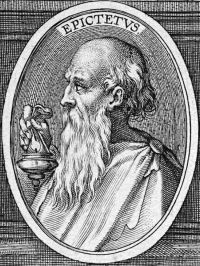
Portrait of Epictetus Epictetus Epictetus, the Discourses as reported by Arrian…

Let not these reflections oppress you: "I shall live without honour, and be nobody anywhere." For, if lack of honour is an evil, you cannot be in evil through the instrumentality of some other person, any more than you can be in shame. [6] It is not your business, is it, to get office, or to be invited to a dinner-party? Certainly not. How, then, can this be any longer a lack of honour? And how is it that you will be "nobody anywhere," when you ought to be somebody only in those things which are under your control, wherein you are privileged to be a man of the very greatest honour?
Source: Wikisource

Portrait of Epictetus Epictetus Epictetus, the Discourses as reported by Arrian…

For one man has a natural talent for one thing, another for another. Do you suppose that you can eat in the same fashion, drink in the same fashion, give way to impulse and to irritation, just as you do now? You must keep vigils, work hard, abandon your own people, be despised by a paltry slave, be laughed to scorn by those who meet you, in everything get the worst of it, in honour, in office, in court, in every paltry affair. Look these drawbacks over carefully, if you are willing at the price of these things to secure tranquillity, freedom and calm.
Source: Wikisource

Portrait of Epictetus Epictetus Epictetus, the Discourses as reported by Arrian…

And if you meet anything that is laborious, or sweet, or held in high repute, or in no repute, remember that now is the contest, and here before you are the Olympic games, and that it is impossible to delay any longer, and that it depends on a single day and a single action, whether progress is lost or saved. This is the way Socrates became what he was, by paying attention to nothing but his reason in everything that he encountered. And even if you are not yet a Socrates, still you ought to live as one who wishes to be a Socrates.
Source: Wikisource

Get perspective with Kwize: daily news enlightened by great literature