Summary

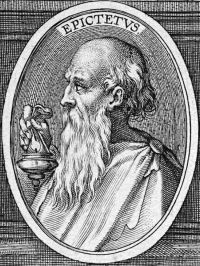
Portrait of Epictetus Epictetus Epictetus, the Discourses as reported by Arrian… (1925)

The use which we make of the external impressions is our one chief concern, and upon the right kind of use depends exclusively our happiness. In the realm of judgement the truth or falsity of the external impression is to be decided. Here our concern is to assent to the true impression, reject the false, and suspend judgement regarding the uncertain. This is an act of the moral purpose, or free will.
Source: Wikisource

Portrait of Epictetus Epictetus Epictetus, the Discourses as reported by Arrian… (1925)

It is, therefore, not unnatural that the one Greek philosopher who, despite the monistic and necessitarian postulates of his philosophy, conceived of his God in as vivid a fashion as the writers of the New Testament, and almost as intimately as the founder of Christianity himself, should have inherited the passion for a personal god from the folk and land of his nativity.
Source: Wikisource

Portrait of Epictetus Epictetus Epictetus, the Discourses as reported by Arrian… (1925)

Therefore, good and evil can be only those things which depend entirely upon our moral purpose, what we generally call, but from the Stoic's point of view a little inaccurately, our free will; they cannot consist in any of those things which others can do either to us or for us. Man's highest good lies in the reason, which distinguishes him from other animals. This reason shows itself in assent or dissent, in desire or aversion, and in choice or refusal, [26] which in turn are based upon an external impression, φαντασία, that is, a prime datum, a "constant," beyond our power to alter.
Source: Wikisource

Get perspective with Kwize: daily news enlightened by great literature