Summary

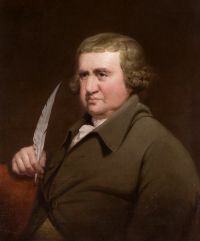
Portrait of Erasmus Darwin Erasmus Darwin The Botanic Garden. Part 2, Containing the Loves of the Plants…

In the Spartium Scoparium, or common broom, I have lately observed a curious circumstance, the males or stamens are in two sets, one set rising a quarter of an inch above the other; the upper set does not arrive at their maturity so soon as the lower, and the stigma, or head of the female, is produced amongst the upper or immature set; but as soon as the pistil grows tall enough to burst open the keel-leaf, or hood of the flower, it bends itself round in an instant, like a French horn, and inserts its head, or stigma, amongst the lower or mature set of males.
Source: Gutenberg

Portrait of Erasmus Darwin Erasmus Darwin The Botanic Garden. Part 2, Containing the Loves of the Plants…

The monsters of your Botanic Garden are as surprising as the bulls with brazen feet, and the fire-breathing dragons, which guarded the Hesperian fruit; yet are they not disgusting, nor mischievous: and in the manner you have chained them together in your exhibition, they succeed each other amusingly enough, like prints of the London Cries, wrapped upon rollers, with a glass before them. In this at least they resemble the monsters in Ovid's Metamorphoses; but your similies, I suppose, are Homeric?
Source: Gutenberg

Portrait of Erasmus Darwin Erasmus Darwin The Botanic Garden. Part 2, Containing the Loves of the Plants…

From all these circumstances I should conjecture, that those female fig-flowers, which are closed on all sides in the fruit or receptacle without any male ones, are monsters, which have been propagated for their fruit, like barberries, and grapes without seeds in them; and that the Caprification is either an ancient process of imaginary use, and blindly followed in some countries, or that it may contribute to ripen the fig by decreasing its vigour, like cutting off a circle of the bark from the branch of a pear-tree.
Source: Gutenberg

Get perspective with Kwize: daily news enlightened by great literature