Summary

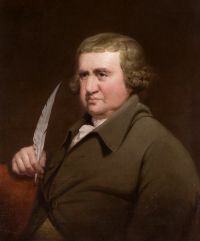
Portrait of Erasmus Darwin Erasmus Darwin Zoonomia, or, the Laws of Organic Life… (1796)

If the dark spectrum is found beneath the centre of the eye, we pursue it from the same motive, and it seems to move downwards. This has given rise to various conjectures of something floating in the aqueous humours of the eyes; but whoever, in attending to these spots, keeps his eyes unmoved by looking steadily at the corner of a cloud, at the same time that he observes the dark spectra, will be thoroughly convinced, that they have no motion but what is given to them by the movement of our eyes in pursuit of them.
Source: Wikisource

Portrait of Erasmus Darwin Erasmus Darwin Zoonomia, or, the Laws of Organic Life… (1796)

Now as Sir Isaac Newton has shewn, that all the different colours are reflected or transmitted by the laminæ of soap bubbles, or of air, according to their different thickness or thinness, is it not probable, that the effect of the activity of the retina may be to alter its thickness or thinness, so as better to adapt it to reflect or transmit the colours which stimulate it into action? May not muscular fibres exist in the retina for this purpose, which may be less minute than the locomotive muscles of microscopic animals?
Source: Wikisource

Portrait of Erasmus Darwin Erasmus Darwin Zoonomia, or, the Laws of Organic Life… (1796)

The length of time taken up in viewing an object, of which we are to observe the spectrum, makes a great difference in the appearance of the spectrum, not only in its vivacity, but in its colour; as the direct spectrum of the central object, or of the circumjacent ones, and also the reverse spectra of both, with their various combinations, as well as the time of their duration in the eye, and of their remissions or alternations, depend upon the degree of fatigue the retina is subjected to.
Source: Wikisource

Get perspective with Kwize: daily news enlightened by great literature