Summary

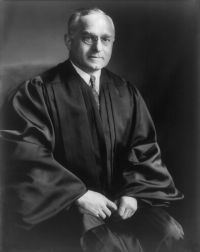
Portrait of Felix Frankfurter Felix Frankfurter Shapiro v. United States (335 U.S. 1…

And so I conclude that the Court has misconstrued the Fifth Amendment by narrowing the range and scope of the protection it was intended to afford. The privilege against self-incrimination is, after all, 'as broad as the mischief against which it seeks to guard.' Counselman v. Hitchcock, supra, 142 U.S. at page 563, 12 S.Ct. at page 198. If Congress by the easy device of requiring a man to keep the private papers that he has customarily kept can render such papers 'public' and nonprivileged, there is little left to either the right of privacy or the constitutional privilege.
Source: Wikisource

Portrait of Felix Frankfurter Felix Frankfurter Shapiro v. United States (335 U.S. 1…

If records merely because required to be kept by law ipso facto become public records, we are indeed living in glass houses. Virtually every major public law enactment-to say nothing of State and local legislation-has record-keeping provisions. In addition to record-keeping requirements, is the network of provisions for filing reports. Exhaustive efforts would be needed to track down all the statutory authority, let alone the administrative regulations, for record-keeping and reporting requirements. Unquestionably they are enormous in volume.
Source: Wikisource

Portrait of Felix Frankfurter Felix Frankfurter Shapiro v. United States (335 U.S. 1…

The Court this day decides that when Congress prescribes for a limited Governmental purpose, enforceable by appropriate sanctions, the form in which some records are to be kept, not by corporations but by private individuals, in what in everyday language is a private and not a Governmental business, Congress thereby takes such records out of the protection of the Constitution against self-incrimination and search and seizure. Decision of constitutional issues is at times unavoidable.
Source: Wikisource

Get perspective with Kwize: daily news enlightened by great literature