Summary

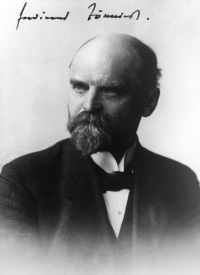
Portrait of Ferdinand Tönnies Ferdinand Tönnies Philosophical Terminology — I.

Law, again, as practised and spoken, taught and explained, on the basis of customary law, moves between popular belief and convention with a much stronger preponderance of that preference for the old. So too the special language of law, which as technical approaches to learned and sacred language, but then as the language of a caste (of an order or faculty) is appropriated and transformed in a more free, i.e., more conventional way. Then too conscious legislation deals with it quite arbitrarily—this we already presupposed—as it does with the law itself and in close connexion with it.
Source: Wikisource

Portrait of Ferdinand Tönnies Ferdinand Tönnies Philosophical Terminology — I.

Understanding is itself a kind of willing, it is the will of recognition, of acceptance, i.e., of appropriation, and thus understanding in common is like possession in common. Thus by understanding a social will issues from the individual will. But the less social validity a word has, the more effort it needs for the individual to make himself understood; he then strengthens by natural signs—tones and gestures—the meaning which he desires to give to the word.
Source: Wikisource

Portrait of Ferdinand Tönnies Ferdinand Tönnies Philosophical Terminology — I.

At any rate we shall allow, what we seldom act upon, that we must not philosophise in words alone, but that the word is a sign indifferent in itself, the value of which depends entirely upon its being appropriately formed and upon its serving to arouse the desired clear and distinct idea, or—in proper, that is abstract, thought—to recall the activity whereby we, or another, or all in common, formed a concept, and thereby to recall the content of the concept.
Source: Wikisource

Get perspective with Kwize: daily news enlightened by great literature