Friedrich Christian Accum’s Description of the Process of Manufacturing Coal Gas, for the Lighting of Streets, Houses, and Public Buildings (1815) is a technical treatise outlining the production and use of coal gas as an innovative light source. Concentrating on the equipment—retorts, gas holders, burners, and pipes—the text explains how coal is converted into flammable gas, highlighting its efficiency, affordability, and advantages over conventional oil and tallow.
Accum emphasizes the societal effects of gas lighting, advocating for its widespread adoption and economic benefits, while also discussing technical aspects such as heat-to-light ratios and measuring instruments. The work underscores coal gas’s contribution to the development of urban infrastructure and industrial output during the early 19th century.
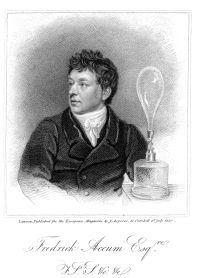 Friedrich Christian Accum,
Description of the Process of Manufacturing Coal Gas…
Friedrich Christian Accum,
Description of the Process of Manufacturing Coal Gas…
