Summary

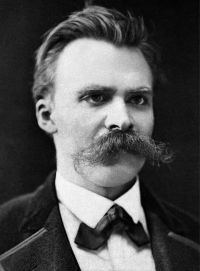
Portrait of Friedrich Wilhelm Nietzsche Friedrich Wilhelm Nietzsche The Twilight of the Idols; or, How to Philosophize with the Hammer…

Must he pay for being so perfect as a reality? Must he make up for his deeds, for the tension of spirit and will which underlies all his deeds, by an eclipse of his powers in matters of the imagination and in absurdity? Hitherto the history of his desires has been the partie honteuse of mankind: one should take care not to read too deeply in this history. That which justifies man is his reality,—it will justify him to all eternity. How much more valuable is a real man than any other man who is merely the phantom of desires, of dreams of stinks and of lies?—than any kind of ideal man?
Source: Gutenberg

Portrait of Friedrich Wilhelm Nietzsche Friedrich Wilhelm Nietzsche The Twilight of the Idols; or, How to Philosophize with the Hammer…

One is necessary, one is a piece of fate, one belongs to the whole, one is in the whole,—there is nothing that could judge, measure, compare, and condemn our existence, for that would mean judging, measuring, comparing and condemning the whole. But there is nothing outside the whole! The fact that no one shall any longer be made responsible, that the nature of existence may not be traced to a causa prima, that the world is an entity neither as a sensorium nor as a spirit—this alone is the great deliverance,—thus alone is the innocence of Becoming restored....
Source: Gutenberg

Portrait of Friedrich Wilhelm Nietzsche Friedrich Wilhelm Nietzsche The Twilight of the Idols; or, How to Philosophize with the Hammer…

The saying of Yea to life, including even its most strange and most terrible problems, the will to life rejoicing over its own inexhaustibleness in the sacrifice of its highest types—this is what I called Dionysian, this is what I divined as the bridge leading to the psychology of the tragic poet. Not in order to escape from terror and pity, not to purify one’s self of a dangerous passion by discharging it with vehemence—this is how Aristotle understood it—but to be far beyond terror and pity and to be the eternal lust of Becoming itself—that lust which also involves the lust of destruction.
Source: Gutenberg

Get perspective with Kwize: daily news enlightened by great literature