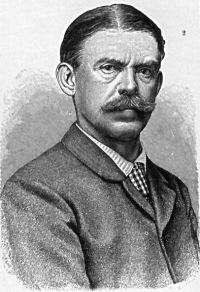
Georg August Schweinfurth

Georg August Schweinfurth

Summary

Portrait of Georg August Schweinfurth Georg August Schweinfurth The heart of Africa, Vol. 1 (of 2… (1873)

There is a peculiar charm in these early morning hours, and no one can wake from his repose in a night-camp in the wilderness without a sense of calm enjoyment of the delights of nature. As soon as the horizon reddens with the dawn the solitude is enlivened by a chorus of ring-doves, here the most frequent of their kind, and by the cackling of guinea-fowl. The traveller is aroused daily by their serenades, and, without much strain upon his imagination, he could almost persuade himself that he has been long resident in the same spot, so familiar does the cooing of the doves become.
Source: Gutenberg

Portrait of Georg August Schweinfurth Georg August Schweinfurth The heart of Africa, Vol. 1 (of 2… (1873)

Distinct, in some respects, from what I had already seen was this district of Mvolo. Far as the eye could reach, there extended a wide grassy plain, broken by huge stones of fantastic outline and by thickets or single trees. Graceful fan-palms waved above the groves, and the autumn tints gave a rich colouring to the scenery, every rock, with its covering of creepers, being a picture in itself. In the north could be seen the three mountains near Awoory, like purple peaks in the pale azure of the horizon.
Source: Gutenberg

Portrait of Georg August Schweinfurth Georg August Schweinfurth The heart of Africa, Vol. 1 (of 2… (1873)

The Seriba, like its environs, was unique of its kind. The formidable appearance of the confused pile-work would have spoilt the night’s rest of any one who had a very sensitive imagination. Something like a picture I remember of the Antiquary’s dream, only without the sea, did the complication of huts stand out against the tall blocks of granite from which the fan-palms started like proud columns. The huts themselves, on their platform of clay, were like paper cones on a flat table. In front was the great farmyard, with its hundreds of cattle under the charge of Dinka servants.
Source: Gutenberg

Get perspective with Kwize: daily news enlightened by great literature